
Batteries not included: Why this old-school lubricator still beats the 'smart' ones in mining’s harshest corners

, , , , , , , , , , , , ,
, ,
,
For over 30 years, GreaseMax has quietly built a global reputation in plant rooms, on mine sites, and beneath conveyor lines. Its calling card? A conspicuous lack of flash. No motors. No batteries. No LEDs. Just a self-contained, chemically powered unit that delivers a precise flow of grease over 1, 3, 6, or 12 months, then stops.
That design is deliberate. And to Milton Holmes, Director of Delta International Sales (DIS), it's what makes GreaseMax more than just another single-point lubricator - it's a lesson in reliability.
"We won't make a battery-powered unit. We never will," Milton says flatly. "After decades in this space, we know the failure modes of battery-driven lubricators. Even if the electrical components don’t fail, internal condensation will threaten their reliability. And in mining, condensation is a constant issue due to ongoing daily temperature cycles."
Milton speaks with the authority of someone who’s lived and breathed the product since the beginning. His team introduced single-point lubrication to Australia in the 1980s, and he's been working in the field ever since.
"Back then, when single point lubrication was a new concept, people couldn’t believe you could just screw a unit on, walk away, and trust it to do the job," he explains to The Rock Wrangler. "It seemed too simple. But that simplicity is precisely why GreaseMax works."

How it works: A chemical reaction, not a motor
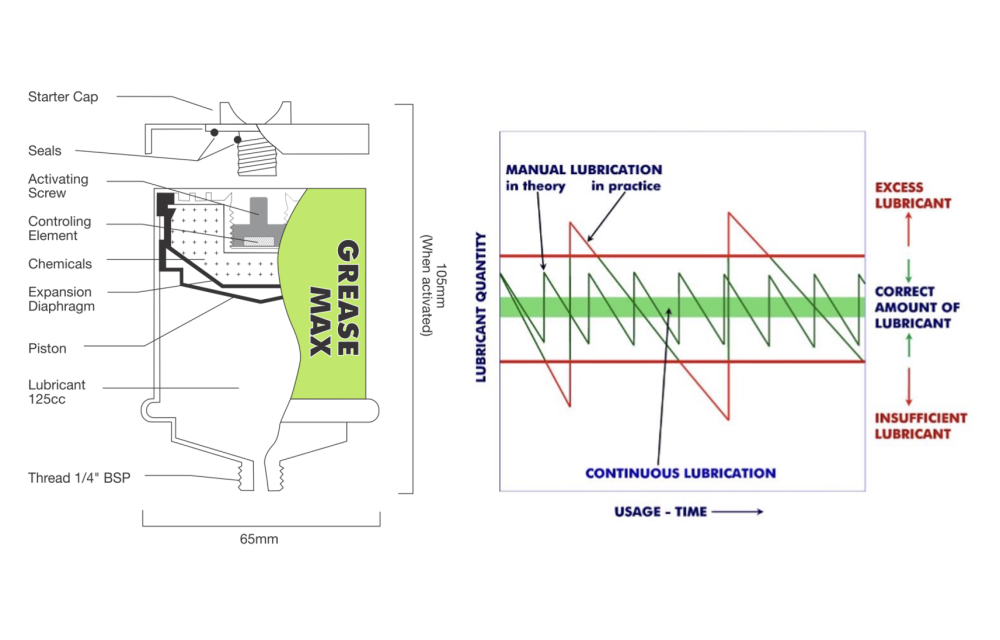
At the core of GreaseMax is a slow, controlled chemical reaction. Once activated, the internal galvanic process generates gas, gradually pushing a steel piston downward to deliver grease through the outlet at a constant rate.
"There’s only one moving part - the piston," Milton explains. "There’s no circuitry, no mechanical components, no setting dials. That’s not a limitation; it’s what makes it reliable in extreme environments."
Each unit is colour-coded based on discharge period: white for one month, blue for three, red for six, and grey for 12 months. And while other lubricators may rely on pressure sensors or programmable controls, GreaseMax sticks to a principle of self-regulation. It discharges continuously regardless of vibration, seal wear, or greaseway resistance.
Set and forget, safely
That predictability gives maintenance planners the confidence to align lubrication schedules with broader servicing intervals.
"Maintenance scheduling requires known start and end points," says Milton. "That’s what GreaseMax provides. You activate it, install it, and you know exactly when it will be empty."
It’s also safe. The units are TÜV-certified for use in hazardous locations, including underground coal mines and petrochemical plants. There’s no risk of electrical ignition, and no need to interact with moving parts during operation.
"It’s safer because there’s no temptation to hand-grease live equipment," Milton notes. "And you don’t have to clamber over machinery to get to inaccessible bearings."

Why the steel body matters
New users often ask why the GreaseMax body isn’t transparent - wouldn’t it be easier to monitor the piston? Milton's answer is firm: the steel body is non-negotiable.
"Steel is what lets us handle high output pressures and heat," he says. "Plastic might seem to have advantages, speciality as the position of the piston can be seen, but in heat it has a risk of deformation. In critical applications, that deformation leads to failure."
As for monitoring lubricant usage, Milton says that's a red herring. "The piston moves so slowly that even if it were visible, you wouldn’t be able to measure it accurately unless you marked it with a micrometre. We tell people: trust the schedule."
Common misconceptions
Milton has heard every myth about automatic lubricators.
"People used to think the grease output depended on the bearing resistance, or that it stopped flowing when the machine stopped running," he recalls. "Neither is true. GreaseMax operates at a constant rate. It doesn’t care what the bearing is doing."
He adds that units should never be used to supply multiple grease points. "Every bearing has a different greaseway resistance. If you split the output, one bearing will get starved. It’s not a T-piece application."
One job, done right
GreaseMax is designed for single-point lubrication. If a bearing needs more grease than one unit can deliver, the solution isn’t to modify the product - it's to install two or more if needed.
"We’ll never make an adjustable model either," says Milton. "To do that would mean adding a control system. More parts, more failure points. GreaseMax is deliberately unadjustable because it works as intended."
And if a plant requires higher output? Simply cluster multiple units into a bracketed system.
Proven in the field
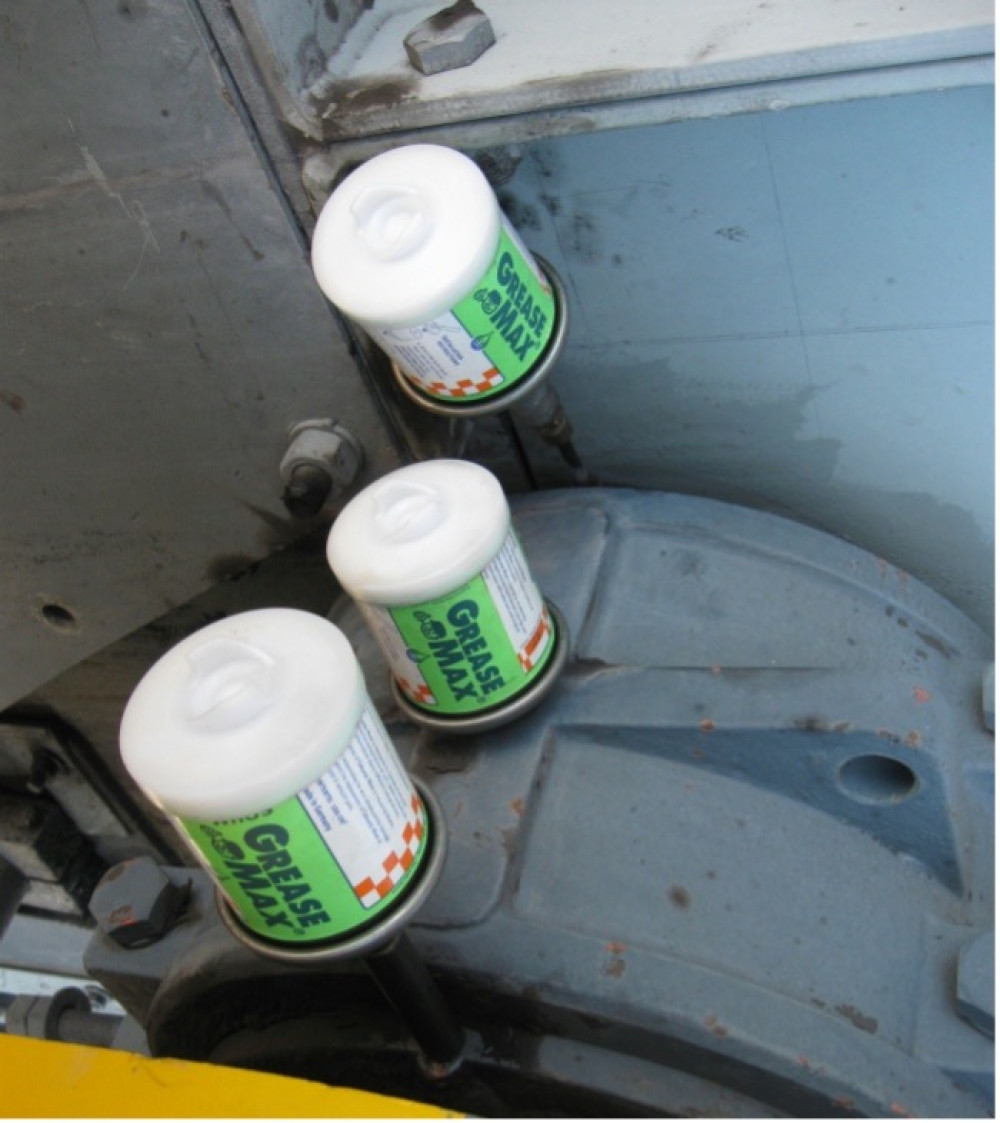
GreaseMax has been used in applications ranging from submerged conveyor chains to vibrating screen housings, from dusty quarry belts to extreme cold in food-grade facilities. It works underwater. It works upside down. It works next to high-vibration motors.
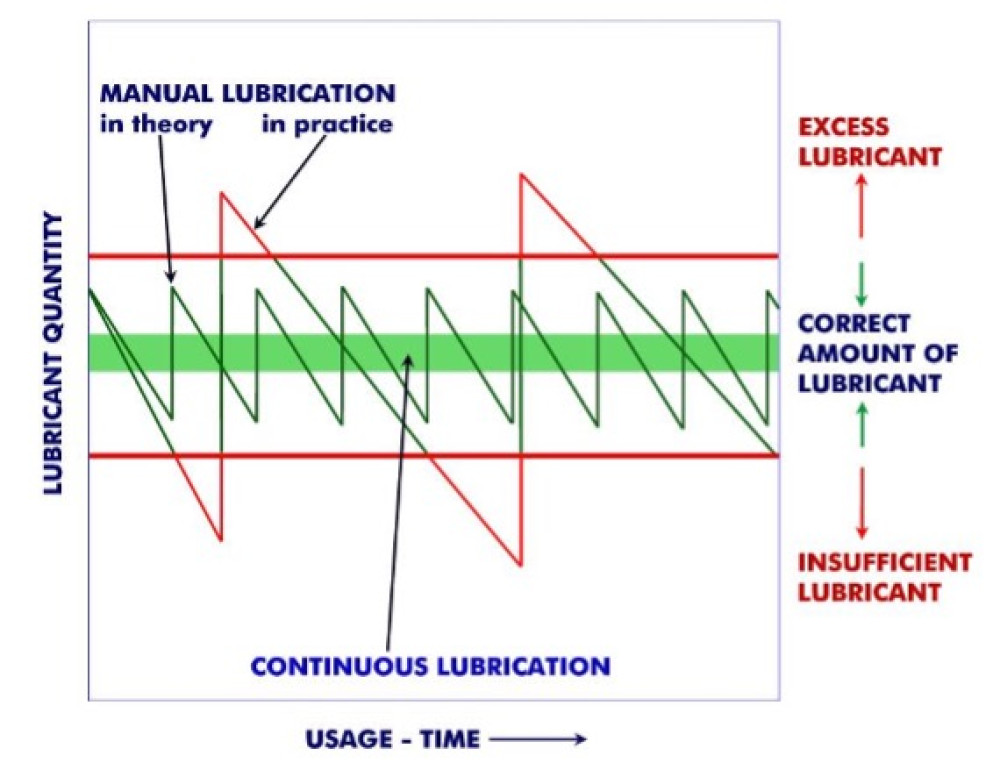
A key advantage is its ability to maintain clean, consistent lubrication in challenging environments. Milton explains that GreaseMax prevents common manual lubrication issues such as overgreasing, contamination, and missed cycles.
"Manual greasing tends to be irregular. Technicians use too much, or not enough, or the wrong grease altogether," he says. "GreaseMax eliminates those risks. It delivers the right grease, in the right amount, all the time."
GreaseMax in numbers
Each unit holds 120 grams of lubricant and is prefilled at the factory with high-grade options, including:
- Multipurpose calcium sulfonate grease for high-load applications
- Heavy-duty moly for slow-moving, shock-loaded bearings
- Food-grade H1 grease for sensitive production areas
Temperature ratings range from -40°C to over 180°C, and the system can be mounted in any orientation. Units work with extension lines, flexible tubing, and brackets, making them adaptable to nearly any layout.
Support from experience
Perhaps most valuable of all is the support that comes with the product. Milton and his team know the market inside out.
"We know our competitors. We know their failure points. And we know how to help our customers avoid them," he says. "If someone has a lubrication challenge, we can guide them to the right solution."
That confidence comes from long service. As Milton puts it, "There’s no one in the world, as far as I know, who’s been working with single-point lubricators as long as I have."
Conclusion: A product with principles
In an age of smart sensors and app-enabled devices, GreaseMax stands out precisely because it isn’t. It doesn’t beep. It doesn’t log data. But it does what it’s supposed to do and it does it without fail.
"Smart simplicity," says Milton. "That’s what people really want when reliability matters. And that’s what we’ve always delivered."
For maintenance managers who are tired of overcomplicated gadgets and questionable durability, GreaseMax offers a back-to-basics solution that simply works. And for Milton, that’s a badge of honour.