
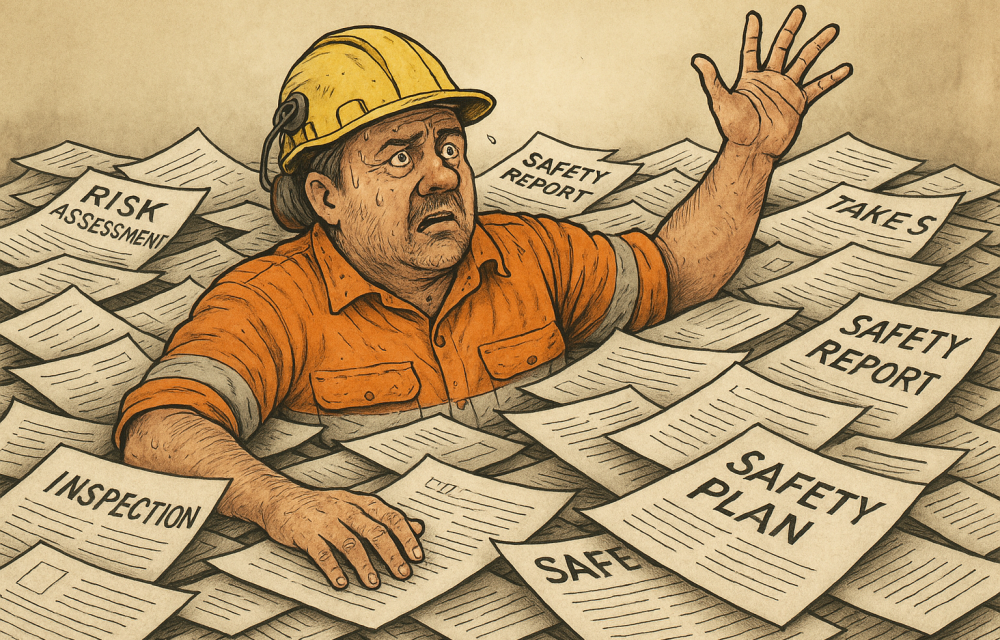
When safety paperwork piles up but safety doesn’t improve, cutting clutter could be the smartest move mining can make

, , , , ,
,
It’s a hard truth that mining professionals might not want to hear: much of what we call safety work - the forms, the checklists, the risk matrices, the “take fives”- doesn’t actually keep people safe.
That was the confronting message delivered by Drew Rae, Associate Professor at Griffith University, at the NSW Resource Regulator’s 33rd Mechanical Engineering Safety Seminar (MESS 2025) in Sydney. In a talk titled “How do we make sure the work of safety doesn’t distract from the safety of work?” Drew challenged industry to rethink its relationship with paperwork, compliance, and the rituals that consume time and money while making little difference to outcomes on site.
“Almost all of the problems we face in safety don’t require an understanding of circuits or turning moments,” Drew told the audience.
“They’re about organisations and people. And yet we’ve built a system full of tasks that don’t actually change the way work is done.”

From engineering to organisational safety
Trained as an engineer, Drew explained that his career path shifted once he realised that technical know-how wasn’t enough to address safety challenges.
“To be good at safety, I had to learn the underlying science of how organisations work and how people interact,” he said. “My research team takes people with technical training and equips them to understand those patterns.”
That perspective has led him to interrogate the gap between what organisations say safety practices are for, and what they actually achieve.
“When someone says, ‘We do a pre-start so people know what’s happening that day,’ we study whether that’s true,” Drew said. “When someone says, ‘We do risk assessments to make better decisions,’ we check if they actually change decisions. When people say, ‘We plan to make sure controls are in place,’ we ask if plans actually result in different controls.”
The consistent finding, he said, is that these activities rarely deliver what they promise.
The rise of the “take five”
No example captures this better than the ubiquitous pre-task risk assessment - known in mining by many names, from “take fives” and “step backs” to acronyms like HYDRA—Have You Done a Risk Assessment.
“These tools actually started in mining,” Drew noted. “We think the Canadians are to blame. From there, they spread like a virus to almost every industry.”
He has even begun collecting examples of take five cards in his office, fascinated by the variety but sceptical about their effect.
“They’re widely described as decision support tools, but under almost every condition we’ve studied, they make zero impact on how the work is actually done,” he said. “Whether people fill them out or not, they may or may not use the right tool, replan a job when things change, or stop when something doesn’t feel right. The card itself doesn’t influence those behaviours.”
Attempts to redesign or enforce take fives haven’t helped. The activity persists, Drew argued, not because it works, but because organisations feel compelled to keep doing it.
What really makes work safe
Against that backdrop, Drew was clear: only four factors truly determine whether work is safe.
- The environment and equipment.
“Mining is uniquely dangerous because of the energy involved, but it’s also uniquely controllable. Sites are isolated and equipment is engineered. The way we design environments has the biggest impact on safety.” - The people present.
“One of the most important moments in safety is when someone thinks, ‘This doesn’t feel right.’ Whether they stop depends largely on whether they’ve got a trusted person next to them who agrees. People make the difference.” - The tools available.
“Having the right tool for the job - including PPE - matters. This is a practical, short-term control with real impact.” - How the work is performed.
“There isn’t always one right way to do a job, but there are always ways that are safer than others. Execution matters.”
“If you’ve got a controlled environment, competent people who care about you, the right tool for the job, and the work being done safely, you are highly unlikely to get hurt,” Drew said.
The persistence of “safety clutter”
So why does safety work continue to pile up? Drew called it “safety clutter”- the accumulation of documents, forms, and processes that organisations struggle to let go of.
“It’s way easier to add safety paperwork than it is to remove it,” he said. “Audits never tell you to reduce procedures. Investigations rarely conclude you need fewer inductions. Inspectors never ask for less documentation. Everything pushes us towards adding, never subtracting.”
Even when executives acknowledge that a practice doesn’t work, inertia takes over.
“I once asked a GM of safety why they didn’t just scrap a process everyone hated,” Drew recalled. “Their answer revealed the underlying problem: it somehow feels safer to add work than to remove it. Even if we know an activity achieves nothing, taking it away makes people anxious.”
The hidden costs
For the mining industry, the cost of safety clutter isn’t just measured in paperwork.
“You’re in a business that carefully tracks dollars per tonne,” Drew reminded the room. “Safety administration is often the marginal cost that decides whether you’re profitable. We spend fortunes on these activities that don’t actually improve safety.”
Worse, misplaced effort can actively reduce safety.
“Look at how much time your supervisors spend supervising compared to filling out forms,” Drew said. “Every minute spent on paperwork is a minute less spent on the floor, giving the real-time guidance that actually keeps people safe.”
Why we really do safety work
If safety paperwork doesn’t prevent accidents, what purpose does it serve? Drew outlined three main reasons.
- To demonstrate safety to others.
“Clients and regulators demand evidence. Risk assessments and documented plans provide a record to defend decisions, even if they don’t change the work.” - To signal that we value safety.
“Signs, slogans, and stand-downs don’t make sites safer, but they show that safety is a social value. They reassure the workforce and the public that we care.” - To feed the management system.
“Many tasks exist because the system demands it. We hope safety will spin off as a by-product of running the system, but often there’s little evidence of direct effect.”
Honesty over slogans
Drew also urged the industry to be honest about competing priorities.
“The dirty secret of mining is that safety is not your number one priority,” he said bluntly. “Making money comes first. That doesn’t mean you want people hurt, but it does mean safety gets deprioritised. Pretending otherwise stops us from having honest conversations about how to manage it.”
He argued that many activities are less about protection and more about managing organisational anxiety.
“Safety doesn’t come from being sure,” Drew said. “It comes from being curious. Statistics and green dashboards make us feel comfortable, but they don’t make us safer. What matters is digging into incidents, asking what really happened, and learning from that.”
A challenge to the profession
Drew closed by reminding the audience that his critique was not aimed at mining alone.
“These patterns exist across industries,” he said. “But mining, with its dangerous environments and heavy energy, also has unique opportunities to focus on what really matters. Too often, the real skill sets of engineers and supervisors are distracted by work that doesn’t improve outcomes.”
His call to action was clear: cut the clutter, and reinvest that time, money, and attention into the four factors that actually shape safety.
Takeaway for Mining Professionals
For mining managers, engineers, and frontline practitioners, Drew’s message is both uncomfortable and practical:
- Audit your safety practices. Do they change environments, people, tools, or work methods? If not, they may be clutter.
- Challenge add-ons. Be wary of new procedures that add burden without evidence of benefit.
- Rebalance supervision. Free up supervisors from paperwork so they can focus on direct, in-the-field safety leadership.
- Embrace curiosity. Replace comfort metrics with meaningful investigation and learning.
The hook for business leaders is straightforward: stripping away ineffective safety work is not only a cultural win, but also a commercial one. In an industry where margins are constantly under pressure, reducing safety clutter could deliver both safer outcomes and leaner operations.