
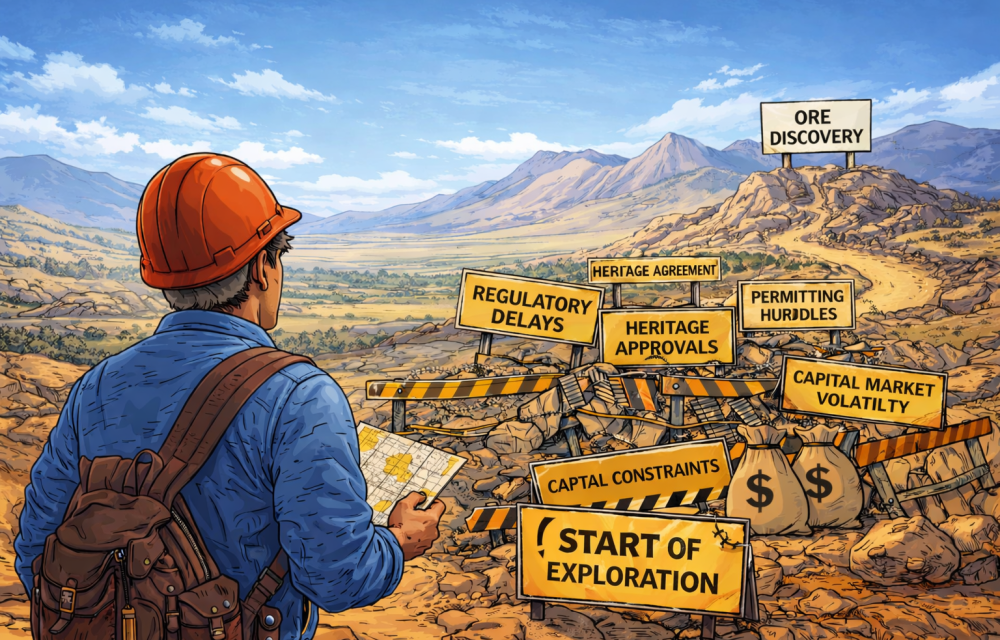
Exploration still works, but getting to the first drill hole now takes longer, costs more, and tests patience before the rocks ever do

, , , , , , , , , , , , , , ,
, , , , , , , , , ,
, , , , , ,
The mining industry is not running out of deposits. It is running into friction.
That was the underlying message from the WA Mining Club’s March luncheon, where a panel of highly experienced explorers unpacked the realities shaping modern mineral exploration. Between them, the speakers have been involved in discoveries worth tens of billions, offering a rare, ground-level perspective on what is changing and what is not.
Their conclusion was clear: the technical ability to find deposits remains strong, but the system around exploration is becoming increasingly difficult to navigate.
Discovery still works when everything aligns
Moderating the discussion was Mark Bennett, executive chairman of S2 Resources and one of Australia’s most successful exploration geologists, best known for leading discoveries such as Nova-Bollinger.
Joining him was Margie Hawke, principal geoscientist at Rio Tinto and the discoverer of the DeGrussa copper-gold deposit in Western Australia. Also on the panel was Dr Mike Jones, managing director of Impact Minerals, who has more than 30 years of experience in mineral exploration and has contributed to multiple gold and nickel discoveries. Rounding out the group was Steve Beresford, an exploration geologist and former chief geologist for several major mining companies, with experience in more than 60 countries.
Mark opened by framing exploration as the foundation of the entire mining value chain.
“If we don’t find it, we can’t mine it,” he said.
Margie reflected on how quickly discovery can translate into development when conditions allow.
“In the field, we set a pretty speedy pace to get that thing into operation,” she said.
The message was simple. When the right combination of land, capital and people comes together, discovery still works, and it can still move quickly.
The starting line is moving further away
Where the discussion shifted was not in geology, but in access.
Mark pointed to the growing complexity of land access, heritage processes and permitting timelines as a major constraint on exploration activity.
“The time and money it takes to get to the starting line is probably between five and ten times more than it was ten years ago,” he said.
Mike agreed, noting that while Western Australia remains a strong jurisdiction, exploration is becoming harder almost everywhere.
“My experience over the last 20 years is it’s just getting harder to work anywhere,” he said.
This shift is particularly challenging for junior companies, which operate with limited capital and are responsible for much of the industry’s early-stage discovery work.
By the time an explorer gets boots on the ground, the market may have moved on, funding conditions may have tightened, and the original opportunity may have lost momentum.
The geology has not changed. Everything else has.
Capital is available but not where it’s needed
Despite ongoing concerns about funding, the panel suggested that capital itself is not the core issue.
Instead, the challenge lies in how it flows through the sector.
Mike described capital raising as a constant pressure for junior explorers.
“It’s a relentless task. When you finish one capital raise, you’re already thinking about the next,” he said.
This dynamic often forces companies to pivot between commodities based on market sentiment rather than geological merit, introducing short-term thinking into what is inherently a long-term process.
Steve challenged another widely held assumption, arguing that early-stage exploration is often misunderstood.
“Early stage exploration is as low risk as it gets,” he said. “We only add risk during the exploration process.”
In other words, the real risk begins when companies commit capital and conviction to a concept that may not ultimately hold up. The challenge is not starting exploration. It is knowing when to keep questioning it.
People remain the industry’s secret sauce
Beyond land and capital, the panel emphasised the importance of people.
Steve described exploration geologists as individuals who are comfortable operating in uncertainty, a defining characteristic of early-stage work.
“It’s about how people deal with uncertainty,” he said.
Margie pointed to persistence and curiosity as essential traits.
“It’s just working through the problems and chipping away at it until you find something,” she said.
Mark added that failure is not an exception in exploration. It is the norm.
“You’ll spend most of your time failing. You only need to succeed once,” he said.
These characteristics, unconventional thinking, resilience and a tolerance for ambiguity, form what the panel described as the industry’s secret sauce.
But they also require the right environment to thrive. Organisations must be willing to support long timeframes, accept failure as part of the process and give geologists the freedom to pursue ideas that are not guaranteed to work.
Without that, discovery becomes far less likely.
Australia remains competitive but not untouchable
Western Australia continues to offer strong fundamentals for exploration, including high-quality geological data, political stability and established infrastructure.
However, the panel acknowledged that the relative advantage is narrowing.
Steve pointed to jurisdictions such as Quebec as increasingly competitive, citing faster processes and strong fiscal incentives. Africa and parts of North America were also highlighted as regions where access to ground can, in some cases, be easier than in Australia.
The implication is not that Australia is losing its position, but that it can no longer rely on it.
In a global industry, marginal changes in time, cost and complexity influence where capital flows and where exploration effort is directed.
The strategic risk: starving the discovery pipeline
A recurring theme throughout the discussion was the structural tension within the industry.
Major mining companies depend on new discoveries. Those discoveries are typically made by junior explorers. Yet juniors are the most exposed to rising costs, delays and capital constraints.
This creates a risk to the long-term pipeline of new projects.
If early-stage exploration slows, the impact will not be immediate. It will be felt years or decades later, when the next generation of projects fails to materialise.
Exploration is the foundation of the mining value chain. Without it, everything else eventually stalls.
Still plenty left to find
Despite the challenges, the panel remained confident in the underlying prospectivity of Western Australia and other mature terrains.
Recent discoveries demonstrate that significant opportunities remain, including in areas that have been explored for decades.
“WA has lots and lots to get,” Steve said.
The issue is not whether deposits exist. It is whether the industry can maintain the conditions needed to find them.
The bottom line
The discussion ultimately pointed to a clear conclusion.
Exploration is not running out of ideas, talent or opportunity.
But it is becoming slower, more complex and more capital-intensive.
And unless those pressures are addressed, discovery will not stop. It will shift.
Not because the resources are gone.
But because it becomes easier to find them somewhere else.
In the meantime, we will continue to gather at luncheons, eat well, agree that exploration is critical, and then return to an industry that makes getting started harder than it needs to be.
Still.
We know how to find ore.
We just need to make it easier to start looking.