
Betting the deep as polymetallic nodules emerge as a billion dollar play to fuel batteries steelmaking and the critical minerals transition

, , , , , , , , , , , , , , , , ,
, , , , ,
, , , ,
It takes a certain type of confidence to suggest the future of clean energy metals might lie four kilometres below the Pacific Ocean – confidence, and perhaps a streak of stubbornness. Gerard Barron, executive chairman and CEO of The Metals Company, has both in spades. Speaking virtually to the AusIMM Critical Minerals Conference in Perth, he pulled no punches in describing the challenges of building a new industry from scratch, the political obstacles that have dogged the deep-sea mining sector, and the technical breakthroughs that his company believes will change the game.

From Darling Downs to the deep
Gerard’s career trajectory doesn’t follow the standard path of a mining executive. He grew up on a dairy farm on Queensland’s Darling Downs, cut his teeth as a technology entrepreneur, and only stumbled into mining when he was asked to invest in a little-known deep-sea venture more than a decade ago.
“I didn’t come from the mining industry,” Gerard admitted, recalling his early involvement with Nautilus Minerals. “I was fascinated by new ideas, and I probably knew too little to be scared of the challenges. That ignorance gave me the confidence to dive in.”
It wasn’t a smooth ride. Nautilus raised capital and built momentum, only to falter amid geopolitical and financial headwinds in Papua New Guinea. Gerard eventually exited, but not before becoming immersed in the world of polymetallic nodules.
Why polymetallic nodules matter
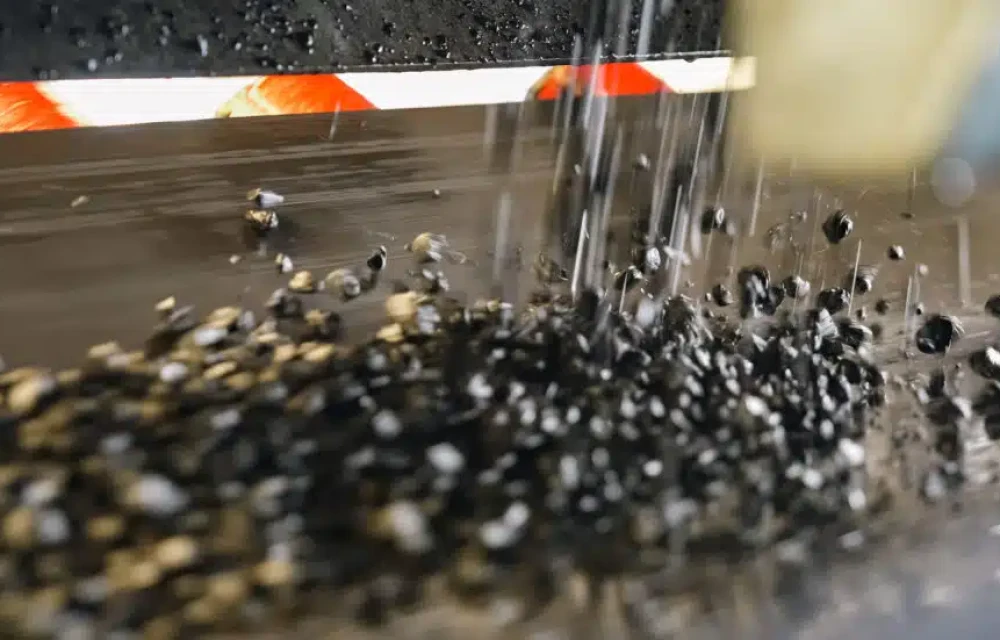
Polymetallic nodules are small, potato-sized rocks that form over millions of years on the abyssal plains of the ocean floor. They develop as metals precipitate from seawater and sediment, creating rich concentrations of nickel, copper, cobalt and manganese. Unlike ore bodies locked underground, nodules sit unattached on the seabed, making them far easier to collect with specialised systems.
Their significance lies in a rare mix of attributes. Each nodule contains four critical metals essential for batteries, clean energy infrastructure and steelmaking. They are found in extraordinary abundance, with estimates of more than 1.6 billion tonnes in The Metals Company’s licence areas of the Clarion-Clipperton Zone. Their grades are also remarkably consistent across wide stretches of seafloor. Just as importantly, processing nodules produces no waste rock or tailings dams, avoiding one of the most pressing environmental and safety challenges of terrestrial mining.
Together, these qualities position nodules as a strategic new source of supply – an alternative to tropical rainforest mining – with the potential to underpin both the energy transition and national security priorities.
That promise shaped the foundation of what would become The Metals Company (TMC). Since its formation in 2011 as DeepGreen Metals, and Gerard Barron’s move into the CEO role in 2017, the company has invested more than a billion Australian dollars in exploration, environmental research and pilot trials.
“Getting a new industry started is damn difficult,” Gerard told delegates. “I’m living proof of just how hard it is.”
TMC’s exploration rights, sponsored by the Pacific nations of Nauru and Tonga, cover vast tracts of the Clarion-Clipperton Zone. In its NORI-D block alone, the company has delineated 1.6 billion tonnes of high-grade nodules and believes a further 300 to 500 million tonnes remain. Each tonne, Gerard argues, could yield more than US$500 worth of payable metals.

Breaking from the UN – a regulatory pivot
One of Gerard’s most striking comments in Perth concerned regulation. For years, the deep-sea mining sector has been stuck in limbo under the International Seabed Authority (ISA), the UN body tasked with writing exploitation rules for international waters. Progress has been painfully slow, bogged down by politics and mounting opposition from NGOs.
“The ISA was meant to put in place a framework not just for exploration, but for commercial exploitation,” Gerard said. “But getting 169 countries to agree on a set of rules has proven impossible. The process was hijacked by NGOs, who influenced governments in Europe and elsewhere to stall.”
The breakthrough came in November last year, he argued, when political winds shifted in the United States. Drawing on decades-old legislation – the Deep Seabed Hard Mineral Resources Act – TMC applied for permits through its U.S. subsidiary with the National Oceanic and Atmospheric Administration (NOAA), bypassing the UN process altogether.
“Re-industrialisation and critical minerals have become national security issues,” Gerard said. “We’d already done the work. We made the decision to take all of the effort from the last 14 years and channel it through the U.S. system. That gives us a path to move forward.”
It’s a bold move, and one that will not go unchallenged internationally. But Gerard was clear: without regulatory certainty, an industry cannot be built.
No tailings, near-zero waste
If the politics of deep-sea mining are fraught, the technical promise is where Gerard sees his strongest argument.
“One of the things that surprises people is that nodules can be processed with no tailings and near-zero waste,” he said. “That’s not something you can say about land-based mining.”
TMC’s approach is deliberately conventional: drying, calcining, and smelting nodules in electric furnaces, much like laterite ore processing. The end products include a high-value manganese silicate, which Gerard described as “a direct replacement for manganese ore,” and a nickel-copper-cobalt alloy that can be refined further.
“They’re porous, consistent in grade, and free of deleterious elements,” Gerard explained. “That makes them much easier to handle. We’ve already produced nickel sulphate and manganese sulphate in trials. And because they sit unattached on the seafloor, we don’t have to deal with waste rock or tailings dams. That changes the environmental equation.”

Picture: The Metals Company
The environmental battleground
That “equation” is exactly where the battle lines are drawn. Environmental groups remain deeply sceptical of deep-sea mining, warning of unknown risks to fragile ecosystems. Gerard acknowledged the criticism but bristled at what he sees as activist-driven distortions.
“We’ve recruited 20 of the world’s leading ocean research institutions, including CSIRO, to study the impacts,” he said. “Yes, we paid for the research, but the scientists were free to publish their findings. We had 50 assets in the water during our 2022 collector trials, measuring everything. The sediment plume stayed within a couple of metres of the seabed. We’re building a weight of evidence that this industry can operate responsibly.”
For Gerard, the comparison to terrestrial mining is the clincher. “At the moment, the growth in nickel is coming from tropical rainforests – the very places on Earth with the most biodiversity. Wouldn’t it make more sense to extract from the places with the least life, like the abyssal plains?”
It’s an argument grounded in first principles, but far from universally accepted.

Economics, partnerships, and road ahead
Beyond the science and politics, Gerard stressed the economics. A recently completed pre-feasibility study (PFS) on TMC’s NORI-D block showed a net present value of US$5.5 billion. At steady state, the company envisions producing up to 12 million tonnes of nodules per year across four production vessels.
“Turning a tonne of nodules into more than US$500 in payable metals puts us in the bottom quartile of the cost curve,” he said. “That’s rare in today’s industry.”
Strategic partnerships underpin the plan. Offshore engineering group Allseas converted a former drillship into TMC’s first production vessel, successfully completing pilot trials in 2022. Pacific Metals in Japan has been trialling smelting routes, while Korea Zinc recently took an equity stake and is eyeing U.S. infrastructure development alongside TMC.
“We’ve been massively oversubscribed on expressions of interest for our first production vessel,” Gerard said. “There’s strong appetite for this product in global supply chains.”

Selling metals as a service?
Gerard also floated a novel idea: selling “metals as a service.” Rather than simply supplying battery manufacturers and other end-users, TMC is exploring rental models where metals are leased and then recovered for recycling at end-of-life.
“It won’t work for every industry,” he conceded, “but in some cases, there’s a real opportunity to change the business model. Because we’re starting fresh, we can think differently.”
It will take a village
Despite the confidence, Gerard acknowledged the scale of the task ahead. “It’s going to take a village to make this industry what it potentially can be,” he said. “We need scientists, engineers, governments, and communities working together.”
Whether TMC can overcome the political headwinds, deliver technically at scale, and persuade a sceptical public remains an open question. But Gerard’s keynote left no doubt that he sees the company’s future – and perhaps the future of critical minerals supply – in the deep ocean.