
Falcon Bolt system slashes intersection support time by over 70 percent, boosting safety and cutting costs at Tomingley Gold Operations underground mine


, , , , , , , , , , , , ,
, ,
,
In a decisive move that rewrote its approach to underground ground support, Tomingley Gold Operations has phased out twin-strand cable bolts in favour of Falcon Bolts—an innovative self-drilling, mechanically anchored system developed by Jennmar Australia. This shift, driven by safety concerns, operational inefficiencies, and rising development demands, not only addressed labour-related risks but also reduced intersection support times by more than 70 percent.
At the AusIMM Underground Operators Conference 2025 in Adelaide, Cornelius 'CJ' Rademeyer, geotechnical engineer at Tomingley, and Robert Galluzzi, R&D engineer at Jennmar, unpacked the collaborative journey behind the transition—from prototype trials to full operational deployment.
The Problem with Cable Bolts
Like many underground operations in Australia, Tomingley had long relied on twin-strand cable bolts to reinforce intersections, brows, and wide spans. But as development rates climbed, so too did exposure to the hazards of manual installation.
“We saw a 50 percent increase in cable bolt requirements between 2022 and 2025,” said CJ. “That came with a surge in back injuries, eye injuries, and silica exposure from grout mixing. Our service crew was stretched—doing more bolting and less of the work critical to supporting production.”
Faced with escalating safety incidents and productivity bottlenecks, the site reviewed three options: acquire a refurbished cable bolter, expand service crew capacity, or adopt a new bolting system altogether. The most promising route was the Falcon Bolt—a self-drilling, pre-tensioned alternative developed by Jennmar.

Enter the Falcon Bolt
Robert Galluzzi described the Falcon Bolt as “fundamentally a self-drilling bolt, but with a mechanical anchor at the toe.” Its design includes a 51 mm custom drill bit, spring-loaded shell for borehole engagement, tensioning nut for pre-loading, and a coupler to enable extension drilling. “Instead of a threaded torque transfer, we use a hex drive—it’s cleaner, faster to decouple, and more operator-friendly,” Robert explained.
The innovation didn’t stop at the bolt. Jennmar also developed a resin injection system mounted in an IT basket, delivering a fast-curing polyester mix (J-Lok P) directly into the hole. This removed the need for bagged grout, mixing bowls, and extended cure times.
“The resin thickens quickly, cures in three hours—and potentially one hour going forward—and offers clean encapsulation without resin run-off,” Robert said.

From Prototype to Production
Trialling began in earnest in 2023. Jennmar and Tomingley collaborated closely through more than a dozen iterations—testing, re-designing, and re-testing based on operator feedback.
“We even had our crews visit Jennmar’s Sydney factory,” said CJ. “That feedback loop was essential. By mid-2024, we had completely stopped installing cable bolts underground.”
Initially, the weaker R32S version of the bolt required 50 percent more drill metres to match the holding capacity of cable bolts. But by late 2024, the new R32X Falcon Bolt—capable of 50-tonne ultimate tensile strength—enabled a one-to-one replacement. “That was the breakthrough,” CJ noted. “It gave us the confidence this system could fully replace cables”.
Time Savings and Cycle Optimisation
The results were staggering. A three-way intersection previously supported with 6.0 m twin-strand cables took 8.5 hours to complete. Using 6.0 m Falcon Bolts with resin, the same job dropped to just over three hours.
“This doesn’t even include the benefit of faster cure times,” said CJ. “We used to wait 12 hours for grout to set. The bolt provides instant tension and the resin is cured within three hours. That opens up our mining cycle massively.”
Time and motion studies showed that while drilling time remained constant, major savings were achieved by eliminating cable pushing, grout mixing, and double handling associated with tensioning and plating. “We’ve gone from a two-crew process down to one seamless operation,” Robert said.

Cutting Costs While Improving Safety
Although the Falcon Bolt system carries a higher material cost, the total cost to support an intersection fell significantly.
Robert explained: “The bolt and resin are more expensive, yes—but you cut out so much from the service crew labour time component that the total cost per intersection is about 80 to 89 percent of the cable bolt cost”.
That figure is conservative, he added. “These time studies were early. Operators have since refined techniques—installing two bolts at once, trimming hose rollouts. We expect those savings to grow.”
From a safety standpoint, the transformation was even more significant. “We no longer mix grout or push cables, so no back injuries or silica exposure,” said CJ. “It’s removed a whole category of risk”.
Built to Scale and Sustain
The system has proven adaptable for scale. While 6.0 m bolts are standard, Jennmar confirmed installations of up to 9.0 m lengths in three-metre segments. “Each segment weighs just six kilos,” said Robert. “Handling’s not an issue”.
The resin system’s shelf life of six months, sealed delivery in IBCs, and minimal maintenance makes it sustainable even in remote locations. “It’s clean, reliable, and intuitive,” said Robert. “A bolt can be fully grouted in under two minutes. It takes longer to roll the hose than to inject an intersection”.
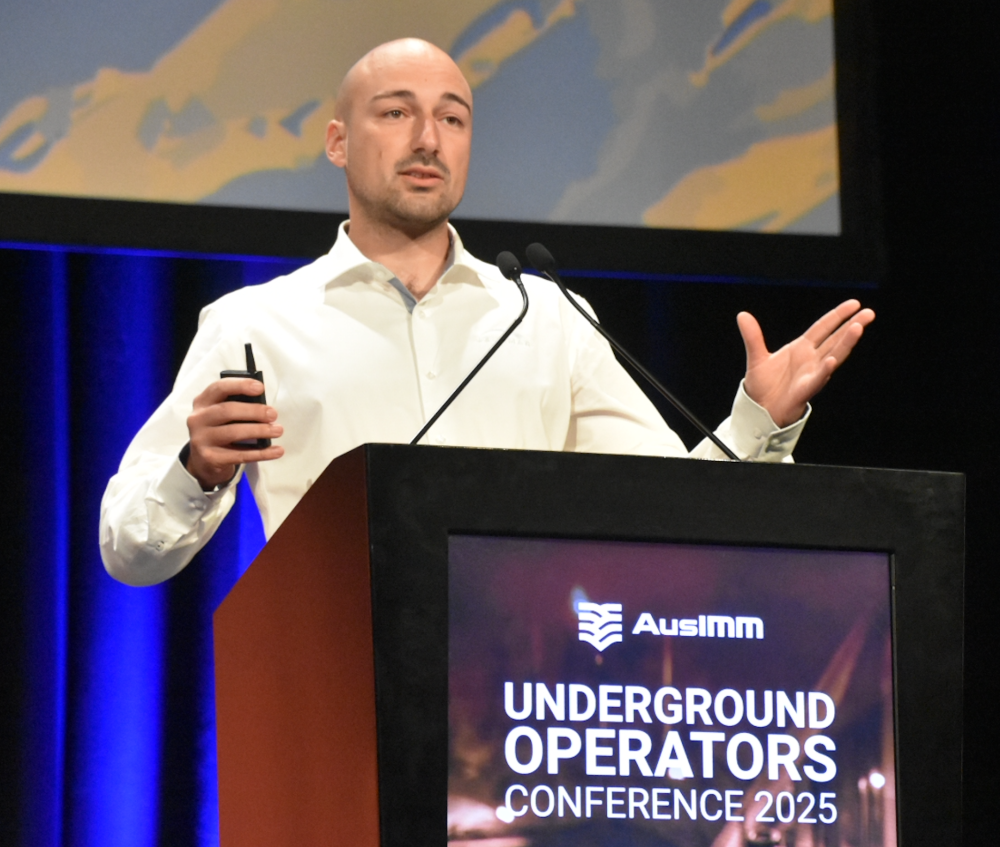
Robert Galluzzi explains the engineering behind the Falcon Bolt system and how collaborative development led to seamless site integration at Tomingley. Photo: Jamie Wade.
Collaborative Engineering Done Right
Both speakers highlighted the strength of collaboration as a key success factor.
“Too often, product designers don’t fully understand the needs of the mine—and vice versa,” Robert said. “But this was different. We incorporated mine feedback through the entire design cycle—bolt, coupling, resin delivery. It’s the smoothest site integration I’ve ever experienced”.
For Tomingley, the result is not just a safer mine, but a faster, more efficient one—with lessons that could scale across the industry.
Looking Ahead
As operations push deeper, faster, and more complex, Tomingley’s Falcon Bolt story offers a compelling case for smart, operator-informed design. Ground support doesn’t have to be the bottleneck—it can be the breakthrough.
“The Falcon Bolt has fundamentally changed how we think about intersection support,” said CJ. “It’s not just about replacing a bolt—it’s about redesigning the whole process.”