
A pail of epoxy, a mill shell worth millions, and the surface prep that decides which one you end up replacing

, , , , , , , , , , ,
, , ,
, , , , , ,
Henkel has moved production of its high impact wearing compound to Victoria and cut lead times by two thirds. For maintenance planners, the more interesting question is what the product is being used to avoid.
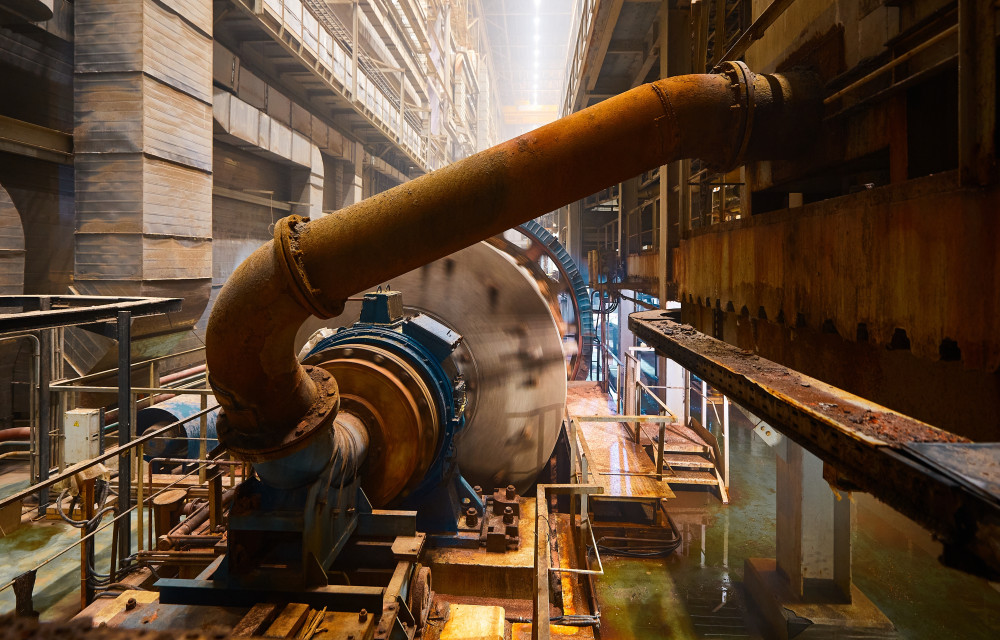
There is a decision made in non-ferrous concentrators more often than people outside the plant would guess. The mill liners are due, the bolts come out, and the backing steel behind them has gone.
In copper, gold, zinc and lead circuits, the slurry and the metal interact corrosively at the interface between the liners and the mill shell. The backing area deteriorates.
The conventional answer is a shell replacement, and according to Henkel that runs to millions of dollars and puts the mill out of service for anywhere between one and three months.
The alternative, increasingly, is a two-part epoxy in a pail.
“Instead, the worn backing area is rebuilt with PC 9313 and the liners are refitted on top, and the mill is back in service in a couple of weeks,” says Kalyan Roychowdhury, Business Development Manager, Infrastructure Protection and Repair, Henkel Adhesive Technologies Asia Pacific.
That is the practical significance of Henkel’s announcement that it has commenced Australian production of LOCTITE PC 9313 High Impact Wearing Compound at its Kilsyth facility in Victoria.
The onshoring is the news. The substitution of a consumable for a capital replacement is the story worth a maintenance planner’s attention.
What the material actually is
PC 9313 is a rubber-modified, ceramic-filled epoxy applied to surfaces exposed to combined abrasion and impact: transfer chutes, hoppers, elbows, cyclones, flumes and troughs, vibrating feeders, dredge pump liners, and rebuild work on ball, SAG and vertical roller mills.

The rubber modification is the point of difference Kalyan draws out. Most ceramic-filled epoxy wear compounds are optimised for sliding abrasion. They cure hard, they resist fine-particle wear, and that hardness costs them toughness, so under impact they chip or break out.
The rubber modification is intended to let the compound absorb impact energy while still curing to a ceramic-like hardness. Henkel rates its impact resistance as superior to ceramic tile.
The cured compound reaches a Shore D hardness of 85, a figure published in Henkel’s technical data sheet. It is rated for dry service between -29°C and +121°C.
The dry abrasion value of 100 mm³ measured to ASTM G65 sits differently. Henkel confirms that number comes from its own ISO laboratory rather than the published datasheet, and says it will be added to the PC 9313 technical data sheet in due course.
The distinction matters if you are specifying against a standard. The hardness figure can be checked against a published document today. The abrasion figure is an internal test result until the datasheet is updated, which is worth knowing if your procurement process requires published data.
It is non-sagging and non-shrinking, which is what allows vertical and overhead application without the material pulling away as it cures.
The performance claims, and how far they go
The field figures are looser, and worth reading as what they are.
Kalyan says Henkel typically observes three to four times the service life compared with the compounds customers were previously using, and that this holds fairly consistently across commodities. He offers a worked example: where an existing compound gave a fortnight of service life in a particular application, PC 9313 ran six to eight weeks in the same position.
A second application he points to is ceramic tiling in chutes and hoppers. As tiles wear, the gaps and edges become, in effect, a speed bump that disrupts material flow and accelerates wear. Filling those gaps to re-establish a smooth surface, he says, can double or triple the life of the existing lining.
Both figures are supplier-reported field observations. No site is named, no commodity is attached to the six-to-eight-week example, and there is no controlled comparison behind the multiplier.
That does not make them wrong. It does mean an operator should treat them as an indication of order of magnitude rather than a specification, and should ask for a reference site in a comparable duty before building a shutdown plan around them.
The catch that matters on site
Kalyan is direct about what determines whether any of this holds up.
“Surface preparation is the single biggest determinant of long-term performance,”
he says. The specification is degreasing, then abrasive blasting with sharp angular grit to a profile of around 75 microns and a cleanliness standard of near-white metal (SA 2½ / SSPC-SP 10), then cleaning and coating before flash rusting sets in.
Mixing is two parts resin to one part hardener, which Henkel confirms holds by volume and by weight alike, applied as a thin scratch coat to wet out the surface, then built up to a minimum of six millimetres.
He then concedes the operational reality: in mining environments and emergency repairs, abrasive blasting is frequently not possible. The fallback is cleaning and degreasing to remove visible contaminants, followed by grinding to roughen the surface.
Asked what that fallback costs in service life, Kalyan puts it at two to three times the life of the compound being replaced, against the three to four times observed on properly blasted substrate. He describes that as the best achievable under prevailing conditions.
For a maintenance supervisor facing a Sunday shutdown with an angle grinder and no blast pot, that is a useful number. The penalty for imperfect preparation is real but not ruinous, and a ground and degreased surface still leaves the repair ahead of what it replaced.
It does mean the headline multiplier should be read as a best case rather than a planning assumption. Three to four times is what a blast pot buys. Two to three times is what most shutdowns will actually deliver.
On timing, the compound has a 30-minute working life at 25°C and cures fully in around six hours at 25°C, with an ideal application temperature range of 10°C to 40°C. On paper, that fits a repair and return to service inside a single shift.
Where Henkel says not to use it
Credit where it is due: Kalyan names the applications where the product is the wrong answer, which is not standard supplier practice.
Where wear is purely severe sliding abrasion from coarse particles with little impact, he points to conventional ceramic tiles and to Henkel’s own PC 7218 Wearing Compound as the better fit. Where an application takes very heavy direct impact from large lump material, he says metallic wear liners still have their place.
In most of those cases, he positions PC 9313 as working alongside those systems rather than replacing them, rebuilding the worn substrate and sealing tile edges so the lining system as a whole lasts longer.
The supply chain question, and the one it creates
The onshoring itself is straightforward. Kalyan says the product was previously imported from the US on lead times of around 90 days, and that local production has brought that under 30 days, roughly a two-thirds reduction.
Around 80 per cent of raw materials are now sourced locally, measured by volume, with the remaining 20 per cent specialty ingredients imported. He traces the decision back to the supply disruption of 2021 and a shift to what he describes as an “in the region, for the region” model, with Kilsyth having produced PC 7218 since 2023.
Volume is a softer basis than value for a local content figure. Bulk resins and fillers occupy most of the volume in a formulated compound, while specialty additives tend to be small in volume and disproportionate in cost. The 80 per cent describes what goes into the pail rather than what it costs to fill it.

The commercial consequence he emphasises is inventory. At 90 days, sites carried contingency stock against freight exposure. With local production and locally held inventory, that buffer requirement drops, and Henkel is increasingly being asked to maintain minimum stock positions on customers’ behalf.
For remote operations, that is working capital coming off store shelves.

It is worth naming the trade-off, because it is not in the announcement. Onshoring converts international freight risk into single-site concentration risk. One facility in Victoria now supplies Australia and New Zealand.
Henkel says it holds contingency plans and maintains inventory in other regions to support business continuity and mitigate supply risk.
That is worth having, though inventory held elsewhere in the region still has to be freighted in. For a site working out how much buffer to carry, the question becomes how quickly rather than whether. Freight exposure has been reduced rather than eliminated, and 20 per cent of inputs still arrive from overseas.
An operator stripping buffer stock on the strength of local production should size that buffer against the continuity of one plant rather than removing it altogether.
What to take from it
For a reliability engineer in a non-ferrous circuit, the mill rebuild application is the item to test. If the choice on the table is a shell replacement at millions of dollars and one to three months out of service against a rebuild measured in weeks, the compound has stopped being a maintenance consumable and become a capital deferral option.
That belongs in an asset strategy conversation, not a procurement one.
For everyone else, the shorter lead time is real and useful, and the inventory saving is real and should be taken with a margin left in place. What decides how much of the service life claim you actually see is the standard of preparation achievable on the day.