
Crushing it with photons and AI - how real-time ore intelligence is helping miners spot value, boost grade and cut waste before the mill


, , , , , , , , , , , ,
, ,
, , , , , , , , , ,
In the race to squeeze more value from every tonne of ore, the mining sector is increasingly looking to data-rich, high-resolution technologies that can keep pace with operational demands. Few embody this shift better than Metaspectral, a Canadian company whose real-time, AI-driven hyperspectral imaging platform is redefining how miners see and sort their ore.
At the helm of this transformation is Francis Doumet, co-founder and CEO of Metaspectral, whose passion for machine vision and practical innovation is evident from the first sentence.
“Our goal is to unlock the molecular secrets of ore - while it’s still moving down the conveyor belt,” Francis explains to The Rock Wrangler. “And to do it in real time, non-destructively, and with enough resolution to actually change the way mining operations make decisions.”
From spectral signatures to smart sorting
Metaspectral’s edge lies in its ability to combine hyperspectral imaging with proprietary AI models that interpret spectral data at the molecular level. This is not your standard sensor setup.
Each particle of ore is scanned using hyperspectral sensors that capture hundreds of narrow spectral bands across the visible, near-infrared, and shortwave infrared ranges. The result? What Francis calls a “chemical fingerprint” for every pixel, revealing the ore’s precise molecular composition.

“Traditional sensors often assess bulk properties or surface characteristics, and they perform reasonably well,” he explains. “However, they can miss the subtle spectral details that reveal the true mineral composition, especially in complex or blended ores. Hyperspectral imaging captures this fine-grained information, allowing us to differentiate materials with much greater precision.”
Metaspectral’s platform processes this enormous stream of data in milliseconds. A key enabler is edge computing, which compresses raw data volumes by up to 70 percent without sacrificing fidelity. From there, AI takes ove-trained to recognise even the subtlest spectral variations that correspond to mineral types, grades, or impurities.
“Our AI doesn’t just classify materials,” says Francis. “It’s trained to detect patterns and relationships in the data that even a skilled geologist or metallurgist might miss. That’s how we can distinguish between, say, two ore types that look nearly identical to conventional systems.”
Real-time decisions at conveyor speed
One of the most compelling aspects of the Metaspectral system is its speed. From scanning ore to delivering actionable insights takes less than a second. That speed opens the door to a host of operational benefits: smarter diversion gates, tighter feed control, and real-time blending adjustments - all without lab delays or sample transport.
“We’re taking something that used to require a lab and a few hours - or days - and compressing it into milliseconds,” says Francis. “That shift alone can have a dramatic effect on plant throughput and recovery.”
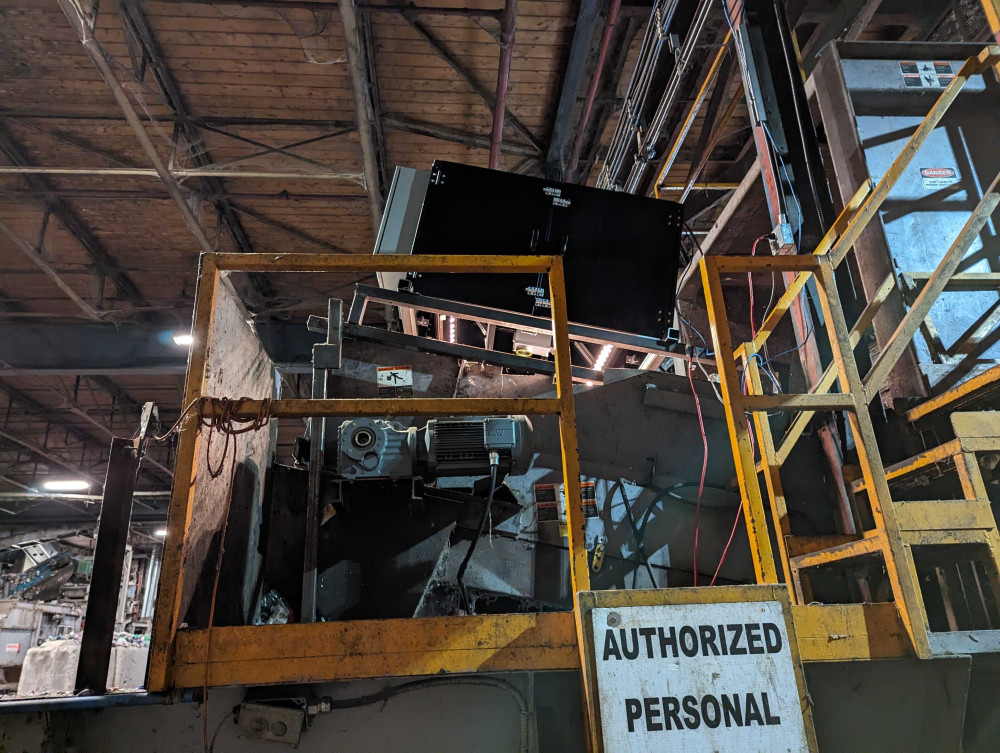
The system is typically installed above conveyor belts at critical hand-off points: after the crusher, before the mill, or in sorting facilities. It feeds live dashboards that give operators instant visibility into grade trends, impurity levels, and mineralogical composition. In more advanced setups, it can connect directly into automated control loops.
Francis is quick to point out that integration is not an afterthought. “Our platform plays well with existing control systems. Whether it’s triggering a sorting gate or adjusting flotation parameters downstream, we want the insights to be usable, not just interesting.”
Precision grade control - and the payoff
The value proposition is as much economic as it is technical. Metaspectral has modelled theoretical case studies showing that even a 1 percent increase in feed grade can yield substantial returns:
- For a uranium operation, the uplift was valued at AU$4 million annually.
- For potash, AU$7 million.
- For gold, AU$1.5 million.
“These aren’t hypothetical benefits,” Francis says. “They’re based on real production volumes and price points. If you can identify and act on even a small shift in ore quality, the return is immediate.”
The platform also supports more sustainable practices. Better targeting and reduced dilution mean lower energy and water consumption per unit of metal produced—an increasingly important consideration in both regulatory and investor circles.
Versatility beyond the belt
While conveyor-mounted applications are currently Metaspectral’s core deployment model, the technology is adaptable to other platforms. Drones, for example, can be equipped with the same imaging and AI stack to monitor open-pit walls, providing up-to-date geochemical maps of exposed ore.
In lab environments, the system supports assay-free analysis of core samples or drill cuttings—further accelerating decision-making in exploration or grade control campaigns.
“Our vision is to create a unified sensing layer that operates across the mining value chain,” says Francis. “From exploration to processing, every step can benefit from more timely, granular data.”

Accuracy in a shifting landscape
A common challenge in deploying spectral systems is maintaining accuracy across varying ore types, lighting conditions, and mineralogies. Metaspectral addresses this with a blend of high-fidelity data acquisition, rigorous AI model training, and adaptive learning.
“We use lab-verified spectral datasets to train our models, ensuring that what we see matches reality,” says Francis. “We also use transfer learning to adapt quickly to new ore bodies, and we validate continuously using XRD and chemical assays. This isn’t set-and-forget AI.”
Localised training data can be incorporated on-site, allowing the system to refine its performance over time—even as geological conditions evolve.
Looking ahead: Critical minerals and energy transition
Metaspectral’s growth trajectory aligns with the global pivot toward electrification and energy-critical minerals. The company is actively expanding its detection capabilities to include lithium, copper, and rare earth elements, which are notoriously difficult to distinguish with conventional sensors.
“These minerals are vital to the energy transition, and they present complex geochemical profiles,” says Francis. “Our system is well suited to identifying them quickly and with confidence, even in mixed or low-grade environments.”
Enhanced AI models under development will further boost the system’s ability to detect trace mineralogical variations and optimise processes like sorting, blending, and reconciliation with even finer control.
A seamless fit for digital-first mining
With its mix of molecular insight, speed, and integration-readiness, Metaspectral’s platform is designed to meet the expectations of a modern, digitally enabled mine site.
“Operators aren’t just looking for data—they’re looking for insight that they can act on immediately,” says Francis. “That’s the bar we’re setting with real-time ore characterisation.”
For a sector under pressure to produce more, waste less, and report transparently, technologies like Metaspectral’s offer not just a technical edge, but a competitive one.
As Francis puts it: “If you can see more, know more, and act faster - you win.”