
Real-time grind control gets an upgrade with a smart sensor that spots off-spec particles early, boosting recovery and slashing reagent costs instantly

, , , , , , , , , , , ,
, , ,
, , ,
In the drive to improve energy efficiency, recovery, and metallurgical precision, a global engineering company has released a quiet disruptor: a machine-learning-enabled sensor that’s helping mining operations monitor and optimise grind size with new levels of accuracy.
Developed by FLSmidth, the Particle Size Analyser (PSA) detects and monitors grind size in real time at the cyclone overflow.
Positioned at this critical point, the sensor delivers a continuous breakdown of particle size distribution, with a focus on the P80 grind size - a key benchmark for downstream recovery performance in flotation and carbon-in-leach (CIL) circuits.
“This is one of the most exciting tools we’ve introduced recently,” Kofi Baah, Global Product Line Manager, Cyclones for FLS’s mining division, told The Rock Wrangler.

“It’s not just a sensor. It’s a strategic tool that gives sites the ability to act as soon as grind size begins to drift.”
Why grind size matters
Grind size has a direct bearing on flotation recovery, reagent efficiency, tailings characteristics, and overall circuit stability.
If the grind is too coarse, valuable minerals may not be fully liberated. If it’s too fine, excessive energy and reagent consumption can erode margins.
Yet despite its central importance, many operations still rely on manual sampling and offline lab analysis to monitor grind size. The problem? It’s often too slow to support timely intervention.
“With PSA, that delay is eliminated,” says Kofi.
“It uses machine learning to calibrate through live sampling, then gives a real-time view of the size fractions in cyclone overflow. It shows whether the process is on target - or not.”
Sites can then take corrective action before off-spec material impacts recovery, leading to improved metallurgical performance, lower reagent use, and significant cost savings.
From insight to intervention
The PSA is a stand-alone product, but It is also designed to function as part of an integrated ecosystem that includes SmartCyclone™ and LoadIQ™ - two automation tools developed by FLS to address long-standing challenges in comminution control.
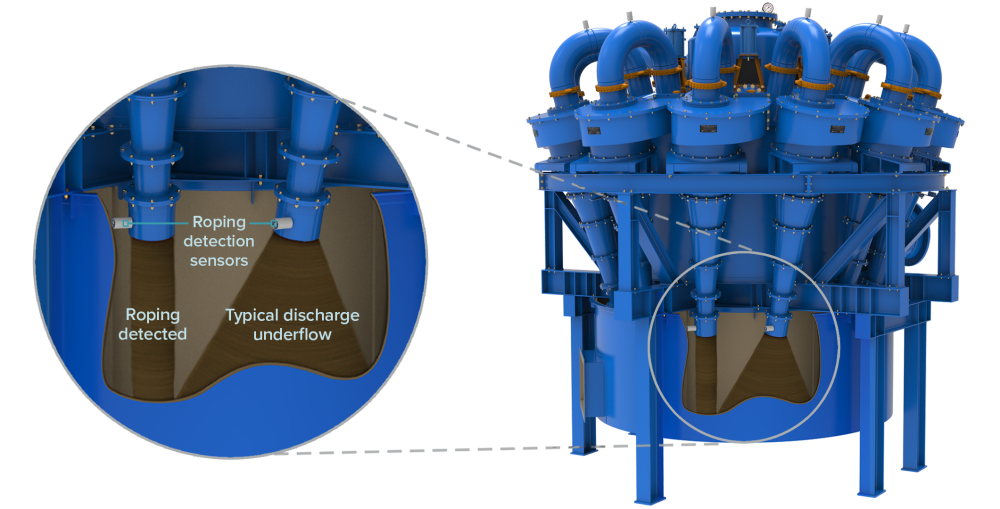
“Together, these tools enable a transition from manual monitoring to proactive circuit control,” Kofi explains. “If PSA detects that grind size is off-target, it communicates with the SmartCyclone™ to detect roping and can adjust cyclone performance automatically, while LoadIQ™ fine-tunes mill load based on real-time sensor feedback.” With these systems, ball addition, mill power, density and feed control can be optimized.
This integrated system closes the loop between sensing, analysis, and automated response.
SmartCyclone™ uses wear and roping detection sensors to monitor individual hydrocyclones for abnormalities. It can detect roping events, track wear patterns across the cyclone cluster, and optimise the number of cyclones in operation to maintain stability and maximise classification efficiency.
LoadIQ™, on the other hand, leverages mill scanner hardware and AI-powered software to calculate the optimal mill load based on ore hardness, liner wear, and charge dynamics. It tracks the location of the toe and cascading material, automatically adjusting parameters such as RPM and volumetric fill to maximise breakage efficiency and reduce liner wear.
“Whereas older systems tried to infer load from bearing pressure - which is affected by temperature, oil condition, and ore density - LoadIQ gives you a direct view of what’s happening inside the mill,” Kofi says.
The result is a closed-loop control system that responds in real time to changes in feed characteristics, equipment condition, and circuit performance.
Designed for operational flexibility
While greenfield operations are embedding these tools early to reduce reliance on scarce skilled labour, brownfield sites are turning to PSA, SmartCyclone™, and LoadIQ™ as retrofit options to unlock additional value from existing infrastructure.
“Greenfields want smart automation built in from day one,” Kofi says. “They’re designing for performance and resilience. PSA helps them get there. But for brownfields, it’s just as powerful. It lets you push closer to design limits with more confidence.”
The technologies are also designed for ease of integration. SmartCyclone’s sensors are wireless and self-powered, eliminating the need for individual node boxes and cable trays. A central handheld controller manages up to 16 sensors, making installation streamlined and scalable.
LoadIQ also installs quickly and requires no batteries or recharging. It operates as a bolt-on upgrade to existing PLCs and expert systems, feeding enhanced dynamic constraints into established control logic without the need to rewrite rules or models.
And with FLS offering ongoing support via a subscription-based service that includes maintenance, spares, and engineering assistance, sites can operate with minimal downtime and maximum confidence without worrying about initial capex cost. “This gives clients peace of mind,” Kofi says. “We ensure the system stays calibrated and reliable while they focus on throughput and recovery.”
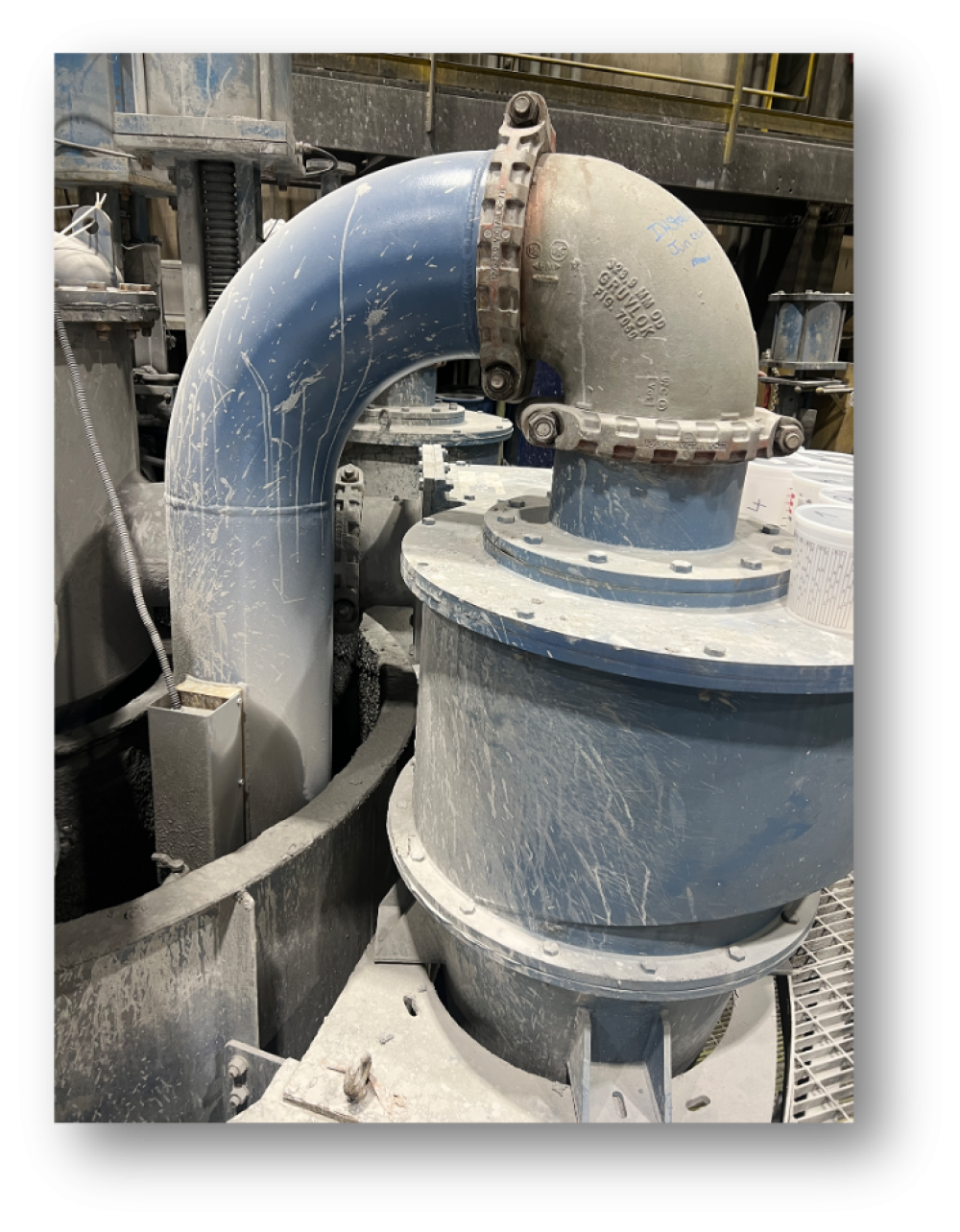
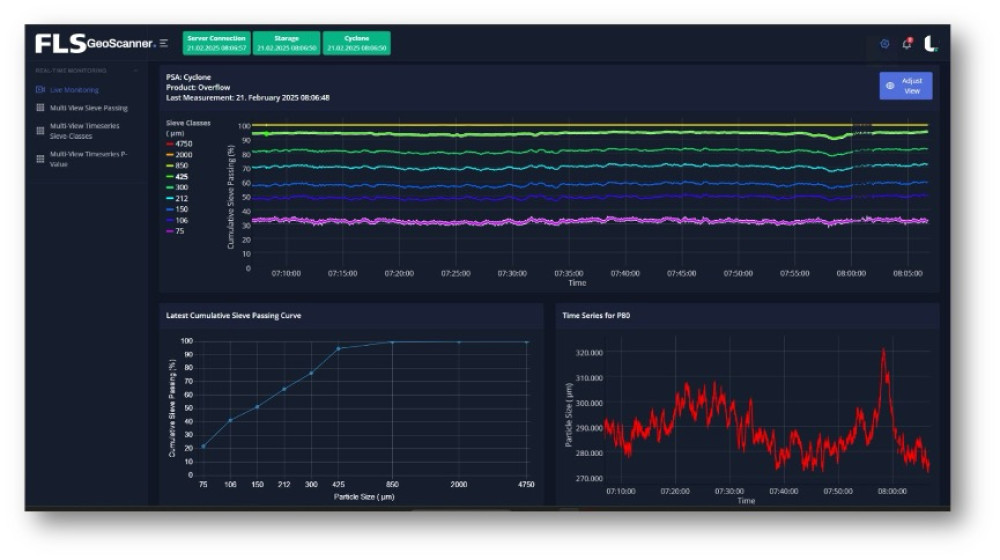
Real-time monitoring dashboard for the Particle Size Analyser (PSA), showing live particle size distribution data from the cyclone overflow. This system provides immediate feedback on P80 grind size trends and enables rapid intervention when off-spec material is detected.
Real-world performance
The results speak for themselves. In one deployment at a copper mine in New Mexico, PSA stabilised grind size in the secondary milling circuit, helping improve recovery and increase plant throughput.
In another case study from a Peruvian gold operation, LoadIQ™ increased throughput by more than 10 percent, cut power usage, and extended liner life - all within weeks of installation, despite the site already having an expert control system in place.
“Every mine is different, but the fundamentals are the same,” Kofi explains. “Real-time data, when used intelligently, drives better decision-making and better performance.”
Operators benefit too. With dynamic limits automatically adjusted based on real-time ore and liner conditions, they can work within stable, responsive set points rather than constantly reacting to unpredictable circuit behaviour.
“Instead of relying on trial and error, operators can focus on optimisation,” says Kofi. “And when the ore changes or the liners wear, the system adapts.”
Looking ahead
As miners face growing pressure to optimise productivity while reducing energy use and environmental impact, systems like PSA, SmartCyclone™, and LoadIQ™ offer a way forward.
“These technologies are about doing more with what you’ve already got,” Kofi says. “It’s about making smarter use of data, automating repetitive decisions, and ensuring every tonne is processed as efficiently as possible.”
With grind size control often acting as the gateway to better flotation recovery, lower reagent costs, and more stable tailings performance, the role of real-time particle analysis is only set to grow.
By combining smart sensing with predictive control, FLS is giving mining operations the tools to move from reactive firefighting to precision-driven, performance-led outcomes.
And in an industry where every percentage point counts, that could be the difference between good results - and great ones.