
The rare earths project where the mine is the easy bit

, , , , , , , , , , , , , , , , , , , , , , , , , , , , , ,
, , , , , ,
, , , , , , , ,
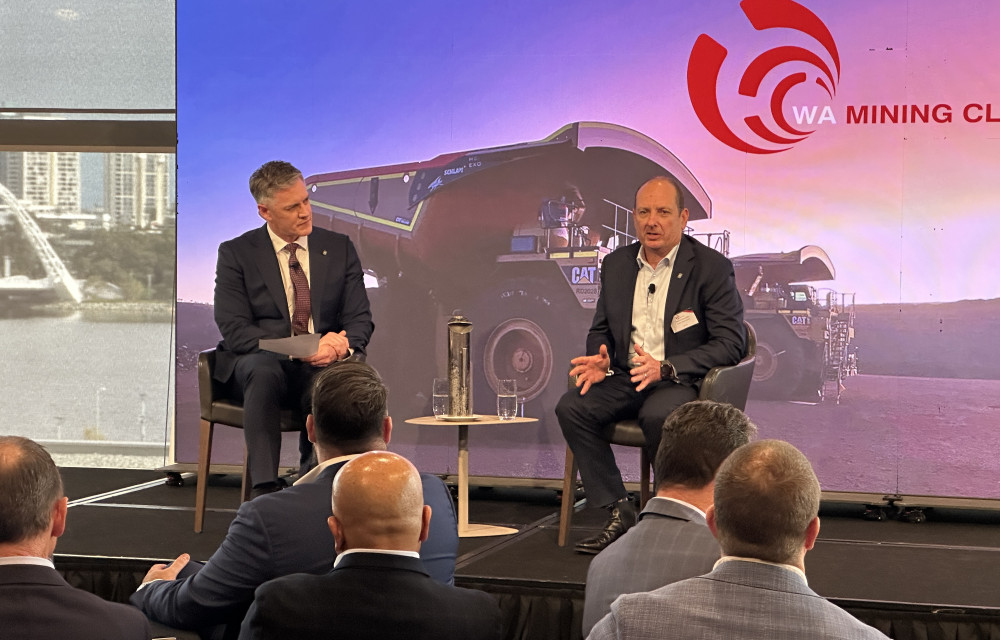
Arafura Rare Earths Managing Director and CEO Darryl Cuzzubbo told the WA Mining Club that Nolans is moving from critical minerals rhetoric to construction reality, but the real test will be processing, ramp-up, suppliers and whether Australia can help build a serious rare earths supply chain outside China.
If mining had a periodic table of difficult jobs, rare earths would sit somewhere between chemistry exam and geopolitical knife fight.
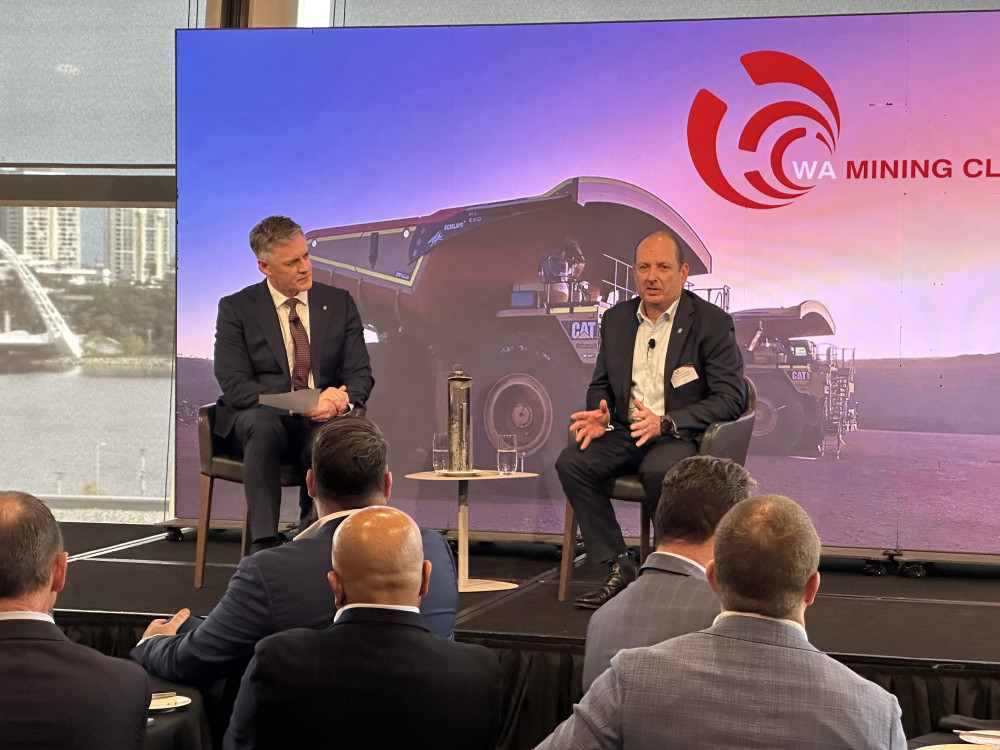
That was the practical message from Arafura Rare Earths Managing Director and CEO Darryl Cuzzubbo during a WA Mining Club fireside chat with Tim McMillan, where the buzzwords around critical minerals, sovereign capability and China supply risk were quickly dragged back to the harder ground of project delivery.
Nolans, Arafura’s rare earths project north of Alice Springs in the Northern Territory, has become one of the most closely watched resources developments in Australia. Not because it is another promising orebody with a strategic-minerals label attached, but because it is trying to do something far more difficult: move from mine to oxide in Australia and offer the world a genuine supply-chain alternative to China.
Darryl made that distinction early.
“If you look at all the rare earth projects, they generally process to a concentrate or carbonate,” he said. “We go all the way to an oxide. What that means is we can be an alternative to China. If you don’t go to that degree, you’re not an alternative to China.”
That line matters because it cuts through much of the critical minerals noise. Mining the material is not the main game. Processing it into a saleable, separated rare earth oxide is where the value, the risk and the strategic significance sit.
Arafura’s May 2026 investor presentation describes Nolans as a fully integrated, single-site mine-to-oxide project with a mine life of more than 38 years, planned annual production of 4,440 tonnes of NdPr oxide and forecast first-quartile cost positioning. The same material puts forecast capex at US$1.191 billion and describes the project as construction ready, advanced in engineering and fully permitted.
A process plant with a mine attached
For conventional mining people, one of the most important comments Darryl made was that Nolans is “more process plant than mine”.
About 90 per cent of the project capex is in infrastructure and the process plant, he said, with only about 10 per cent in the mine. That changes the risk profile completely.
This is not a story about simply mining, crushing and shipping. It is about beneficiation, hydrometallurgy, solvent extraction, process control, reagent management, maintenance discipline and the safe integration of a large chemical-processing operation in a remote part of Australia.
Darryl compared the complexity to Olympic Dam, saying Nolans brings together the mine, beneficiation plant, complex hydrometallurgical plant and solvent extraction separation plant.
“The trick is how you bring all of that together and operate it as an integrated complex plant,” he said.
Arafura has appointed Hatch as EPCM contractor, with Darryl describing Hatch as “number one in the world” for the kind of process engineering capability Nolans requires. The company’s investor material also highlights a fully piloted flowsheet, including beneficiation, wet phosphoric acid processing, purification, cerium removal and separation of rare earth oxides.
The project’s process route is central to its economics. Darryl pointed to a breakthrough about six years ago, when Arafura’s team changed the flowsheet so the phosphate-hosted orebody could be used to generate phosphoric acid for the process. That saved reagents, created a saleable by-product and reduced the neutralisation burden.
“That triple whammy effect takes us from the middle of the cost curve way down to the bottom of the cost curve,” he said.
Construction is close, but ramp-up is the real test
Arafura announced a positive final investment decision in May 2026, with construction targeted to start in September, subject to completion of remaining funding, shareholder and finance milestones. In its 30 June business and offtake update, the company said priority activities around reinstating site-based camp facilities, water and power had been completed, putting it in a position to commence construction in September as targeted.
During the WA Mining Club discussion, Darryl said construction would take a little over three years, followed by a two-year ramp-up.
That ramp-up is the bit that keeps him awake.
“The thing that keeps me up at night the most is the ramp-up,” he said. “I know that will be tough, but I know that’s the upside.”
For mining professionals, that is probably the most useful part of the discussion. It is easy to talk about critical minerals strategy. It is harder to stabilise a complex plant, build the right maintenance systems, train the workforce, prevent process excursions and produce on-spec product for customers who need reliability.
Darryl identified three priorities for ramp-up success: people and culture, maintenance, and operating technology.
“The culture has to suit the complexity of the plant,” he said. “This is really about process control, seeing issues and preventing them.”
That is where Nolans becomes a case study for the next generation of Australian mining projects. The industry has spent years talking about moving further down the value chain. Nolans will test what that actually means in the field: deeper technical capability, greater tolerance for complexity, stronger maintenance discipline and better integration between miners, engineers, metallurgists, software, contractors and operators.
The supplier brief is simple
For the mining supply chain, Darryl’s message was blunt and useful.
Arafura needs capable partners, but it does not want gold-plated solutions.
“We are looking for people that give us the minimum viable solution,” he said. “We’re looking for the Toyota, not the Mercedes.”
That should be printed out and stuck on the wall of every supplier chasing Nolans work.
The opportunity is significant. The project will need capability across construction, infrastructure, process plant packages, power, water, transport, camp operations, laboratory services, maintenance, shutdowns, contract mining and logistics. Arafura’s 30 June update said the company, Hatch and ICN-NT had begun procurement roadshows aimed at connecting Territory capability to project opportunities.
But Darryl made it clear the first gate is safety.
“We’re not going to have a fatality,” he said. “That is number one. We can’t say we care about people and enable a fatality.”
The second gate is capital discipline. Nolans is pre-revenue, heavily funded and under pressure to deliver to its funding profile. The company needs partners that can challenge scope, simplify where possible and help deliver safely, on budget and on schedule.
The Fortescue comparison was telling. Darryl recalled not believing Fortescue could build its Pilbara iron ore business at the capital intensity it claimed, only to see the company largely deliver.
“One of the things that enabled that was the partners that brought that mindset,” he said. “That’s what we need.”
WA’s role in an NT project
Although Nolans is in the Northern Territory, the conversation kept coming back to Western Australia.
Darryl said the NT was not yet a mature mining jurisdiction in the same way as WA, and he sees WA capability as central to supporting the project.
“See the Northern Territory, and our project, as your natural extension,” he told the room.
That is a practical call to action. WA’s mining ecosystem has deep capacity in major project delivery, remote operations, process plant support, mining services, logistics, safety systems and workforce mobilisation. Nolans may be physically closer to Alice Springs than Perth, but much of the know-how needed to build and operate it sits in WA’s contractor, engineering and service base.
Arafura’s project economics clarification gives a sense of the operating model ahead. It outlines assumed contractor requirements in mining, laboratory, camp operations, logistics, shutdown maintenance and other services, alongside a direct labour model covering processing, maintenance, HSE, administration and commercial roles.
For the supply chain, the message is not just “there is work coming”. It is “there is work coming, but the customer is looking for disciplined, practical, safe and cost-aware partners”.
China, pricing and the market that has to change
The geopolitical backdrop to Nolans is impossible to ignore.
Darryl said China had prevented the development of a rest-of-world rare earths sector by controlling pricing, often to the point where even Chinese producers were not making money. His preferred solution is not asking customers to pay a vague “non-China premium”, but building an independent and transparent seaborne price index.
“If it’s independent and transparent, then the price will reflect the market fundamentals,” he said.
That matters because rare earths are not traded like copper or gold. Financing these projects is harder when investors and lenders cannot easily benchmark prices. Pricing uncertainty becomes project risk, and project risk delays the very supply diversification governments say they want.
Arafura’s latest business and offtake update supports that shift. The company announced a binding term sheet with a member of an Indian industrial group for up to 500 tonnes per annum of rare earth magnet feed, including NdPr, Dy and Tb, with pricing to be based on a seaborne traded index.
Darryl also put the cost argument in plain terms. He said the rare earth content in an electric vehicle is a tiny fraction of the overall vehicle value, asking whether a car manufacturer would pay an extra US$30 to enable a US$46,000 vehicle to roll off the production line.
That is a strong way to frame the sector’s central pricing question. If secure rare earths supply is essential to EVs, wind turbines, robotics, aerospace, defence, phones, tablets and medical imaging, then the industry needs pricing mechanisms that support investment in supply diversity.
Arafura’s presentation describes rare earths as a “linchpin” to future-facing industries, with NdPr oxide used in permanent magnet applications that underpin high-value sectors.
Government support has moved beyond speeches
Nolans also shows how far critical minerals policy has moved from speeches and strategy papers into direct financial architecture.
Darryl said the US had changed the market by backing Mountain Pass and introducing a floor price. He was also broadly positive about Australian government support, saying Australia had more tools than any other country he knew of.
“They can come in on the debt, they can come in on the equity, they can come in on the offtake, they provide a production tax credit,” he said.
Arafura’s presentation identifies strategic support from parties including Hancock Prospecting, the National Reconstruction Fund Corporation, Export Finance Australia and KfW. It also outlines more than US$1 billion in conditionally approved debt finance for Nolans, including Export Finance Australia, the Northern Australia Infrastructure Facility, Export Development Canada, KEXIM and ECA-covered tranches.
For the broader mining industry, this is a marker of where project finance may be heading in strategic commodities. The old model of resource, feasibility study, offtake, debt and equity is being overlaid with national-interest considerations, allied supply chains, export credit support, government equity and downstream industrial policy.
That will not suit every project. It will also come with scrutiny, conditions and complexity. But for strategic minerals where market structures are distorted or dominated by one country, it may be the only way to get new supply built.
The social licence opportunity
Darryl also spent time on Alice Springs and Indigenous employment, and this deserves more than a token mention.
Nolans is about 135 kilometres north of Alice Springs, giving it access to the town’s airport, rail yard and services. Darryl said the project could bring infrastructure, capability, direct employment and contractor opportunities to the region.
He also spoke strongly about the impact employment can have for people facing disadvantage, drawing on his Olympic Dam experience with Indigenous recruitment programs.
“When you give someone that’s employed a job, it’s a job,” he said. “When we gave them a job, we gave them hope, ambition, financial independence, discipline and self-belief.”
It was one of the more human moments in a discussion otherwise dominated by funding, processing, geopolitics and procurement. It also points to a bigger truth: if Nolans succeeds, it will not only be judged by oxide tonnes and offtake contracts. It will be judged by whether it leaves behind capability in Central Australia.
The hard part starts now
Nolans has all the ingredients of a modern mining story: critical minerals, China risk, US intervention, Australian government backing, Hancock on the register, advanced processing, Indigenous employment, regional development and a large construction task.
But the most important takeaway for mining professionals is simpler.
This project will be won or lost in execution.
Darryl’s presentation to the WA Mining Club was compelling because it did not pretend otherwise. The mine is not the hardest part. The chemistry is hard. The ramp-up is hard. The market structure is hard. The supplier discipline is hard. The social licence task is hard. Building a reliable rare earths supply chain outside China is hard.
That is exactly why the industry should be watching.
Nolans is not just a rare earths project. It is a test of whether Australia can take a strategic resource, process it properly, fund it intelligently, build it safely and operate it reliably enough to matter in the global supply chain.
For a mining industry that has spent years talking about moving up the value chain, Nolans may be where the conversation finally has to earn its keep.