
No country for old haul trucks

, , , , , , , , , , , , , ,
, ,
,
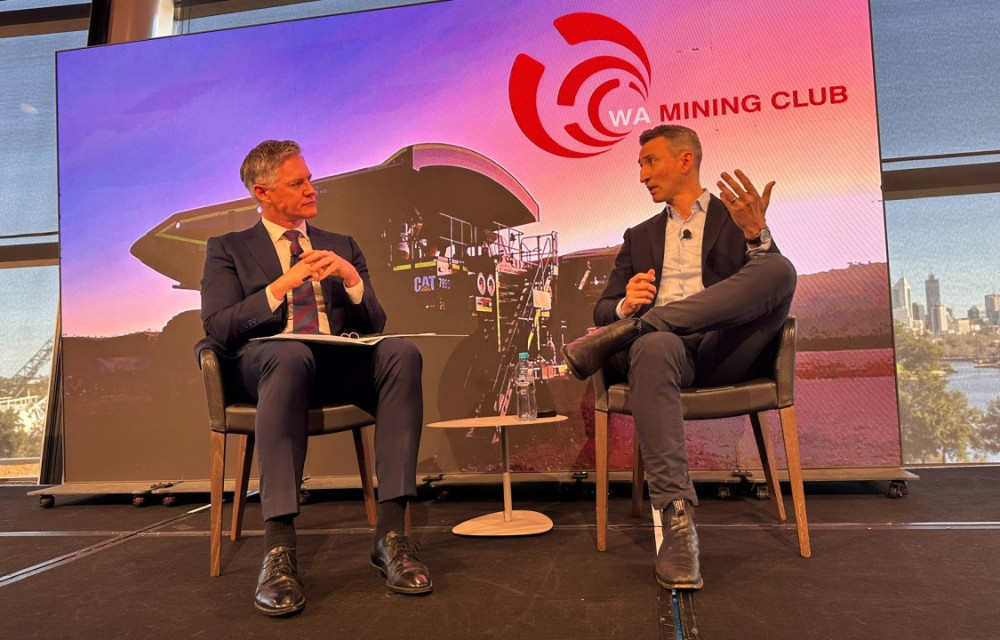
The WA Mining Club wanted Aaron Morey’s last word on Four Corners – what it got was a more revealing argument about mining, technology and the dangerous appeal of simple answers.
There is a moment at every industry luncheon when the polite program gives way to what the room really wants to talk about.
Thanks to Slido, that moment now comes with a leaderboard.
The most popular question put to Chamber of Minerals and Energy of WA chief executive Aaron Morey was not about uranium, approvals, China, capital gains tax, industrial relations or the future of the Canning Basin.
It was about Four Corners.
Morey had recently appeared in the ABC program examining BHP’s Pilbara decarbonisation plans, where he defended the industry’s contention that battery-electric heavy haulage technology was not yet ready to operate at full Pilbara scale.
The Slido question noted that he had been “grilled”, congratulated him for defending the sector and asked what he would say if Four Corners were in the room and he had the chance to deliver the final word.
You could feel the audience lean forward.
The room had handed its chief advocate a rhetorical baseball bat and pointed helpfully towards the piñata.
Morey declined to swing.

No complaints department
Four Corners had portrayed him fairly, he said.
He had expected worse.
The interview had been the most intense of his career, with 30 or 40 minutes of hard, fast questioning designed to throw him off balance. He had learned from it, liked the reporter and would agree to another interview.
“Come back for another chat,” was the essence of his answer.
It was not what the question was fishing for, which made it easily one of the most interesting answers of the afternoon.
An industry that frequently complains about being misunderstood had just watched its peak advocate refuse an invitation to complain about being misunderstood.
That deserves some credit.
It also revealed something useful about Morey.
He is not a miner, geologist or engineer. His professional background is in economics, policy, politics, strategy and advocacy. His value to the sector lies partly in his ability to walk into uncomfortable rooms, understand the question behind the question and argue the industry case without sounding as though he has mistaken a press release for holy scripture.
The Four Corners exchange also provided the perfect frame for his luncheon address, because the central issue was not whether mining should decarbonise.
The real argument was over what counts as evidence that the technology is ready.
A dot on Google Earth
Morey had arrived at the WA Mining Club armed with a Cormac McCarthy quotation, several geopolitical charts and a Google Earth image containing a very small dot.
The dot, he believed, was a Caterpillar 793 haul truck weighing roughly 240 tonnes.
He offered $20 to the first person who could identify the mine, with one guess each and no machine-gun list of possible answers.
It may have been the first mining luncheon competition based on satellite reconnaissance.
But the image was doing more than chasing audience participation.
The truck, Morey explained, operates around 22 hours a day. It moves from a maintenance area into the pit, climbs out under load and travels to a crusher approximately 1.6 kilometres away.
That alone is challenging.
The more important detail was visible in the same image. One part of the mine had already been exhausted and the active mining area had shifted.
The haul route was not fixed.
The pit geometry, gradients, working faces, dumping points and travel distances would continue changing throughout the life of the operation.
That is the real-world problem hiding behind the television-friendly question of whether electric haul trucks “work”.
A battery truck can operate successfully in a trial. It can look particularly convincing when filmed from a drone at sunrise.
But a production fleet must do more than move.
It must maintain payload, availability and cycle times in extreme heat. It must integrate with charging systems, renewable generation, batteries, workshops, mine planning and dispatch. It must operate as the pit changes around it without turning one of the world’s most productive mining regions into an exceptionally expensive parking area.
Morey also dealt with the standard rebuttal.
Yes, an electric fleet may already be operating at a coal mine elsewhere. But a mine using 70 or 80-tonne trucks, minimal overburden, a fixed deposit and a predictable route between the coal face and a conveyor is not directly comparable with a changing Pilbara iron ore operation.
Different mine. Different duty cycle. Different problem.
This was a much stronger argument than the television shorthand that “the technology isn’t ready”.
It showed the working.
Two transitions, not one
The most practically useful part of Morey’s argument was his decision to divide mine decarbonisation into two distinct challenges.
The first is stationary electricity generation.
Replacing diesel and gas generation with combinations of wind, solar, batteries and supporting infrastructure is not simple, particularly in remote systems. But it is increasingly understood and already being deployed across the Goldfields, Pilbara and Mid West.
The second challenge is heavy haulage and rail.
That is where the frontier remains.
The distinction matters because these are not merely two technologies. They are two markets operating on different clocks.
Renewable generation, storage, microgrids and associated infrastructure are increasingly procurement opportunities.
Heavy-haul electrification remains heavily weighted towards testing, demonstration, systems integration and operational proof.
For METS companies, engineers and technology developers, the commercial message was clear.
Sell proven generation and storage capability into today’s projects.
Treat electrified haulage as a longer campaign involving trials, partnerships, mine-specific engineering and a high tolerance for technical uncertainty.
Morey described the Pilbara as the world’s biggest laboratory for this work.
That was not hyperbole.
If battery-electric haulage, dynamic energy transfer and electric heavy rail can be made reliable across enormous, continuously changing Pilbara operations, the resulting technology and operating knowledge will have an export market well beyond Western Australia.
The opportunity is much larger than the truck.
It includes power systems, chargers, trolley assist, batteries, thermal management, digital twins, fleet scheduling, automation, road design, maintenance, workforce training and the unglamorous but essential work of making several promising technologies function as one production system.
BHP, Fortescue and the referee who refused to blow the whistle
When asked who was right, BHP or Fortescue, Morey declined to choose.
Fortescue is pursuing a faster, more aggressive pathway and accepting greater technology and execution risk.
BHP is moving more cautiously, placing greater emphasis on proven technology, reliability and capital discipline.
Morey’s position was that nobody was entirely right or wrong because the sector was still working through the problem.
It was a diplomatically immaculate answer.
It was also probably the only responsible one.
Mining history is littered with absolute predictions delivered confidently just before technology, commodity prices or operating reality made fools of everyone involved.
Fortescue may prove that faster electrification is technically and commercially achievable.
BHP may prove that caution avoided premature capital deployment and operational disruption.
Both companies may be right at different mines, at different times and under different operating conditions.
The difficulty for BHP is that the Four Corners story was not only about engineering.
It also questioned the gap between public ambition and internal capital allocation.
That remains the awkward part of the debate.
An argument that technology is not ready can be entirely legitimate. It does not automatically answer why approved renewable projects were delayed, why emissions ambitions were reduced or how purchasing diesel equipment with a long operating life aligns with future commitments.
The industry cannot rely indefinitely on “the technology isn’t ready” as a complete communications strategy.
It will need to show what has been tested, what failed, what remains unresolved, what capital has been committed and what measurable conditions must be reached before full deployment proceeds.
The public does not need to be told that mining is complicated.
It needs to be shown precisely where the complications lie.
From resilient to indispensable
The haul-truck discussion was the centrepiece, but it sat inside a much larger argument.
Morey’s view is that the post-Cold War economic order is finished.
The world is becoming less trusting, less integrated and less interested in allowing pure economic efficiency to determine where strategic products are made.
Governments are expanding defence spending, rebuilding industrial capability, restricting trade and seeking control over energy, minerals and critical supply chains.
Neoclassical economics, Morey declared, was dead.
Industry policy had returned.
His geopolitical case was built around the Strait of Hormuz, a body of water roughly 30 kilometres wide with shipping channels narrowing to about one kilometre.
For the Perth audience, he helpfully translated that distance into approximately the trip to the Sawyers Valley pub, a location that had apparently played a formative role in his childhood exposure to second-hand smoke.
The humour masked a serious point.
Even in an economy obsessed with cloud computing, artificial intelligence and supposedly weightless digital services, the world still depends upon ships moving through narrow channels, mines producing physical materials and energy systems capable of keeping industry alive.
Hydrocarbons are not only transport fuels. They are embedded in chemicals, fertilisers, plastics and much of the material infrastructure modern societies barely notice until supply is interrupted.
Morey’s interpretation of current events was that governments in Moscow, Tehran, Beijing, Washington and elsewhere were learning the same lesson.
International power rests partly on access to energy connected to an industrial and defence base.
This was the foundation for his strongest line of the luncheon:
It is not enough to be resilient. Australia must be indispensable.
Rocks are not strategy
Western Australia has a persuasive list of ingredients.
Iron ore, gas, gold, lithium, bauxite, nickel, rare earths and other commodities place it at the centre of global conversations about defence, electrification, energy security and advanced manufacturing.
But geology alone does not make a jurisdiction indispensable.
A resource becomes strategically important only when it can be explored, financed, approved, developed, powered and delivered reliably.
This is where Morey’s optimism came with a warning label.
Capital is mobile.
Approvals delays have consequences.
Energy must remain reliable and competitive.
Industrial relations risk matters.
Tax policy can determine whether the next dollar is invested in Western Australia, South America, Africa or somewhere with a less impressive orebody but a more predictable pathway to production.
His message to government was essentially that Australia should stop treating its strategically valuable industries as though they will remain globally competitive regardless of how much regulatory, fiscal and energy-policy weight is placed on them.
His message to industry was less comfortable.
Being strategically important does not excuse weak performance, poor transparency or inflated promises.
Indispensability must be earned through execution.
The last word Four Corners did not get
The luncheon audience wanted Morey to land a final blow on Four Corners.
Instead, he said the program had treated him fairly and invited its reporter to return.
That was not weakness.
It was the more confident response.
Mining’s future arguments will not be won by insisting critics are hostile, journalists are ignorant or the public is incapable of understanding technical complexity.
They will be won by showing the work.
Explain the duty cycle.
Explain the changing mine plan.
Explain the charging constraints, energy requirements, infrastructure risks and difference between a successful prototype and a reliable production fleet.
Then publish the milestones and allow the claims to be tested.
Morey’s central message was that WA mining’s best days may still be ahead because the world will require more minerals, more energy and more industrial capability.
The sector also has an opportunity to solve some of the hardest engineering problems on the planet.
But there is no country for old haul trucks forever.
The diesel fleet will eventually have to give way.
The real contest is over who solves the replacement, who can make it work at Pilbara scale and who is willing to show enough evidence to bring the public along for the ride.
And if Four Corners wants another interview, Morey says the door is open.
One suspects he may bring the Google Earth slides next time.
About the author
Jamie Wade is the publisher and editor of The Rock Wrangler, a mining industry platform focused on exploration, production, processing and METS. A journalist, editor and B2B media professional with more than 30 years’ experience, he also publishes Australasian Drilling and founded major-project intelligence platform Projectory. His work connects mining suppliers, industry stories and commercial opportunities with the people who can act on them.