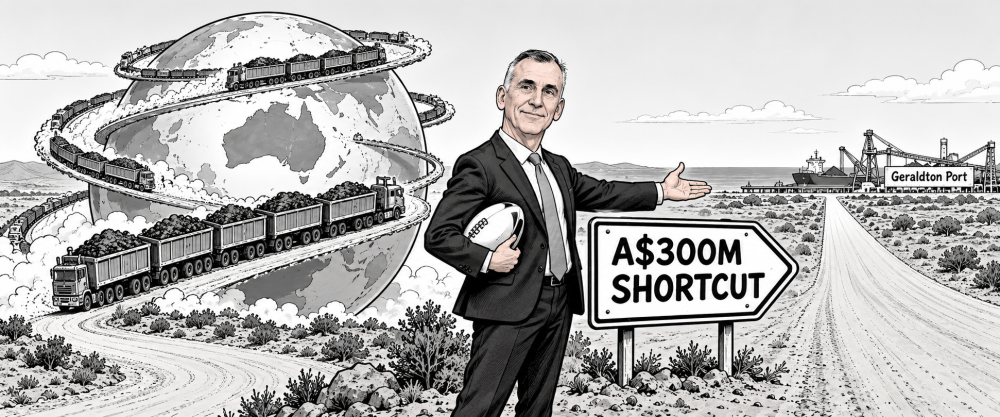
Three laps around the planet, a $300 million shortcut and a former Wallaby with a plan to get WA’s Mid West iron ore moving. What could possibly go wrong?

, , , , , , , , , , , , , ,
,
,
Every day, Fenix Resources' road trains travel a combined 120,000 kilometres, the equivalent of three laps around the planet, hauling iron ore across WA's Mid West, and now former Wallaby John Welborn reckons a $300 million shortcut could help transform the region's mining industry, provided he can get the economics right, keep shareholders happy and resist talking about rugby long enough to build the bloody thing.
There's something wonderfully Australian about an industry that spends billions of dollars digging up rocks, only to discover that the really expensive bit is getting them somewhere else.
It's a problem that's kept mining executives, engineers and investors occupied for generations. Find an enormous mineral deposit in the middle of nowhere, spend a fortune proving it's worth mining, then realise the nearest port is half a continent away.
Congratulations. You've discovered a logistics company with a mining problem.
Which brings me to John Welborn.
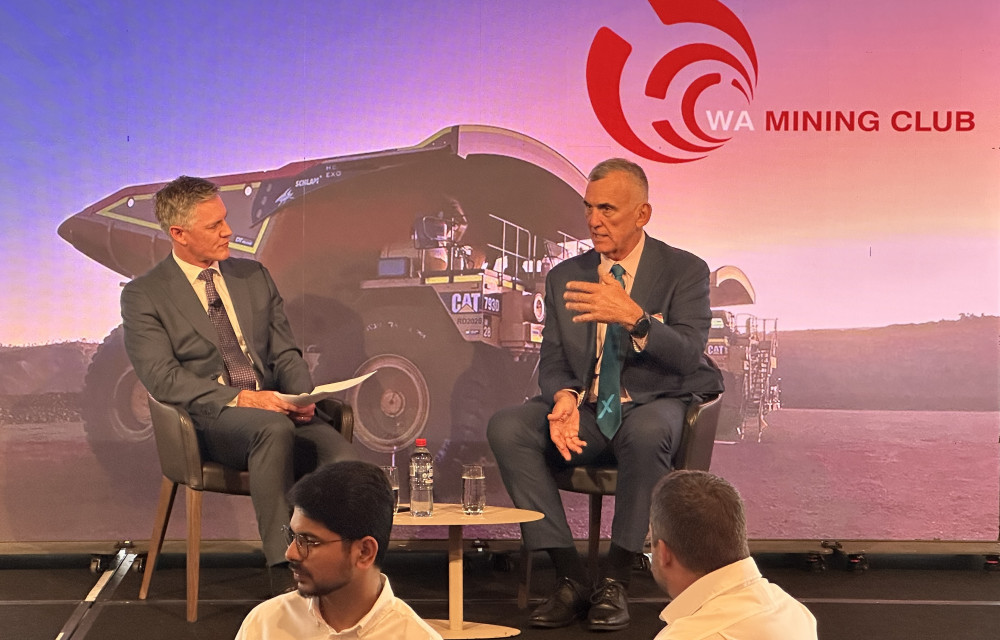
The Fenix Resources executive chairman fronted the WA Mining Club at Optus Stadium on Friday, 23 October, for what was advertised as a fireside chat about his company's ambitious plans for the Mid West.
The fireside chat format is an interesting concept. Two blokes sit on stage, one asks questions and the other provides answers. At least, that's the theory.
When one of those blokes is a former Wallaby who enjoys a good yarn, the arrangement becomes somewhat less predictable.
Moderator Tim McMillan had clearly been warned.
The event's promotional material contained enough rugby references to qualify as a coaching manual, and Tim's introduction suggested he was under strict instructions to keep Welborn talking about iron ore.
He made a respectable effort.
For a while.
First, the elephant in the room
Most mining executives begin these occasions with a carefully choreographed procession of reassuring statements.
Production is up. Costs are under control. The balance sheet is strong. The outlook is exciting.
And somewhere on slide 37, usually in a font requiring a magnifying glass, there's a reference to the risks.
Welborn took a slightly different approach.
He opened by pointing out that Fenix's share price was at a five-year low.
Well, that's one way to warm up the shareholders.
Here was a company producing around five million tonnes of iron ore a year, employing hundreds of people, generating substantial revenue and paying dividends.
And the market was treating it with roughly the enthusiasm normally reserved for a parking ticket.
To his credit, Welborn didn't pretend otherwise.
Nor did he spend the afternoon complaining that investors simply didn't understand his company.
Instead, he explained the business, its challenges and the rather substantial bet Fenix is making on the future of the Mid West.
It was a welcome change from the usual corporate practice of describing every setback as an exciting opportunity to enhance stakeholder value.
Around the world in 90 trucks
Fenix's business model can be summarised in five words.
We mine it, we move it.
The first part sounds relatively straightforward.
The second requires a fleet of enormous road trains hauling iron ore approximately 500 kilometres to Geraldton.
Welborn explained that the company was operating around 90 quad road trains, each about 60 metres long and carrying roughly 150 tonnes.
Collectively, they travel around 120,000 kilometres every day.
That's approximately three laps of the planet.
Every bloody day.
Think about that next time you congratulate yourself for walking 10,000 steps.
Somewhere in the Mid West, a truck driver has done another lap of Earth before morning tea.
And, unlike your Fitbit, the truck needs diesel, maintenance, tyres, a properly rested driver and somewhere to unload 150 tonnes of rock at the other end.
It also needs to navigate public roads shared with tourists, caravans and school buses.
Which rather sharpens the mind when it comes to safety.
Welborn demonstrated the company's digital operations system, which allows management to track vehicles, monitor fatigue indicators, follow production and check what's happening at the port.
He can apparently sit in his Perth office and see what's happening across virtually every part of the business.
I suspect that makes ducking out for an unscheduled smoko considerably more complicated than it once was.
But there's a serious point here.
For all the industry's fascination with artificial intelligence, automation and the latest technological wizardry, there's enormous value in simply knowing where your equipment is, what it's doing and whether the person operating it is fit for the task.
Not particularly glamorous.
Rather useful, though.
A $300 million plan to save 100 kilometres
Then came the proposed private haul road.
Fenix wants to build approximately 244 kilometres of road, largely within the corridor previously associated with the grand Oakajee rail ambitions.
The idea is to shorten the journey between its mines and Geraldton by about 100 kilometres and connect more efficiently with existing rail and port infrastructure.
Estimated cost?
Around $300 million.
Which is a considerable amount to spend avoiding a detour.
Most of us would simply put up with the roadworks.
But when you're moving millions of tonnes of iron ore, 100 kilometres is not a minor inconvenience. It's fuel, tyres, labour, servicing, time and money.
A lot of money.
More importantly, the road could help unlock mineral deposits that have been sitting around waiting for infrastructure since roughly the invention of the wheel.
The Mid West has a long history of ambitious iron ore proposals.
There have been grand plans for railways, ports, mines and entire new export industries.
Some have advanced. Others have disappeared into the familiar mining industry filing cabinet marked Excellent Project, Awaiting Funding.
Welborn's approach is different.
Don't wait for someone to build the entire railway and port network. Start with what you've got, build what you need and expand incrementally.
It's not especially romantic.
There's no grand vision of a completely new industrial city rising from the red dirt.
Just a bloody long road and a business case.
Sometimes that's precisely what a region needs.
The great iron ore disappearing act
What struck me most was Welborn's candour about costs.
He acknowledged that Fenix is presently a relatively high-cost iron ore producer.
That's not something you generally hear shouted from the rooftops at an investor presentation.
The company's September quarter C1 cash costs reached $81.80 per wet tonne, above its full-year guidance range.
Fenix's longer-term ambition is to reduce that figure to around $55 a tonne through increased production, better infrastructure and a more efficient supply chain.
If it succeeds, that would be transformational.
If it doesn't, it will have spent a great deal of money building a very nice road.
And therein lies the problem with mining economics.
It's possible to produce record volumes, employ hundreds of people, deliver substantial revenue and still find yourself working remarkably hard to generate a respectable profit.
Fenix recorded almost $590 million in FY26 revenue, but net profit after tax was only $12.3 million.
That's an awful lot of iron ore to move for a relatively modest bottom line.
It also explains why mining executives tend to become particularly animated when discussing operating costs.
Every dollar saved per tonne matters.
In this business, the difference between prosperity and financial discomfort can be measured in dollars, kilometres and litres of diesel.
The most important real estate in the Mid West
Welborn made another point that deserves more attention.
He believes port access is fundamental to unlocking the value of bulk commodities.
Fenix owns three on-wharf iron ore storage sheds at Geraldton.
Not particularly glamorous assets.
No infinity pools. No harbour-view apartments. Probably not much demand from Airbnb.
Yet Welborn reckons their replacement value is roughly twice the company's current market capitalisation.
The catch is that you can't simply wander down to Geraldton and build another set of sheds whenever the mood takes you.
Port infrastructure is constrained, expensive and difficult to replicate.
It's also exposed to the weather.
In August, surge conditions at Geraldton Port contributed to substantial shipping delays.
And when the port stops, the problems ripple backwards through the supply chain.
Ships wait. Stockpiles fill. Trucks need somewhere to tip. Mines need to adjust production.
Somewhere, an accountant develops a nervous twitch.
The Mid West Ports Authority is building a $95 million surge-protection breakwater, which is expected to substantially reduce weather-related downtime.
It's a reminder that some of the most valuable investments in mining aren't necessarily in mines.
Sometimes they're in roads, sheds, conveyors and things that stop waves.
China, iron ore and the race nobody wants to win
The conversation eventually turned to the future of WA iron ore and China's increasingly assertive approach to purchasing the commodity.
Welborn was asked about the implications of centralised Chinese buying arrangements, changing payment terms and additional global supply.
He remained optimistic.
His argument was that the established Pilbara producers have such enormous economies of scale that they remain exceptionally competitive, even as margins come under pressure.
He also suggested that new high-grade supply doesn't automatically spell disaster for lower-grade Pilbara products because steelmakers blend ores to achieve particular specifications.
The broader point was that the world still needs steel.
And plenty of it.
Wind farms need steel. Infrastructure needs steel. The energy transition needs steel.
Even the people confidently predicting the demise of iron ore generally make their predictions while sitting in buildings containing considerable quantities of the stuff.
Welborn also believes the Mid West's magnetite deposits could become increasingly important as steelmaking technologies evolve.
There's certainly an interesting opportunity there.
Although, as with most things in mining, the distance between a promising resource and a profitable operation is usually measured in billions of dollars and several environmental approvals.
And then there was rugby
Naturally, the afternoon eventually wandered onto the rugby field.
Welborn recalled facing the All Blacks as a young Western Australian representative in 1992, when one of his teammates walked through the haka.
An interesting tactical decision.
Particularly when facing a team that was already substantially better than yours.
According to Welborn, the All Blacks responded by scoring 16 tries.
Which rather suggests the strategy didn't have the desired effect.
He also discussed his Wallabies career, the 1999 Rugby World Cup and the unusual circumstances surrounding his original selection for representative rugby.
Apparently, he accompanied a mate to a schoolboys trial, was handed a jersey to make up the numbers and ended up getting selected.
His mate missed out.
There's probably a useful lesson about networking in there somewhere.
Turn up, meet the right people, and you never know what might happen.
In my experience, mining industry networking usually results in a few business cards, a possible sales lead and a slightly optimistic commitment to catch up for coffee.
Welborn ended up playing for Australia.
Clearly, I've been attending the wrong functions.
The bit that matters
For all the rugby stories, impressive operational dashboards and ambitious production forecasts, I came away thinking that the most interesting part of Fenix's strategy has little to do with Fenix itself.
It's about the Mid West.
Western Australia is extraordinarily good at discovering mineral deposits.
We're also pretty good at digging them up.
Where things become difficult is when somebody has to work out how to move the product economically from a remote location to an international customer.
The Pilbara solved that problem through enormous deposits, enormous capital investment and infrastructure built for enormous volumes.
The Mid West has never enjoyed quite the same advantages.
Its resources are more dispersed, its infrastructure more fragmented and the economics considerably less forgiving.
Welborn is effectively arguing that the region doesn't need another heroic, all-or-nothing development proposal.
It needs a practical way to connect existing assets, reduce costs and build capacity over time.
That strikes me as a proposition worth exploring.
Not because Fenix is guaranteed to succeed.
It isn't.
The company still needs to complete its feasibility study, secure financing, build the infrastructure and prove the operating costs stack up.
The iron ore price could also have a few opinions of its own.
But if the approach works, it could offer a useful model for unlocking stranded mineral resources elsewhere in Western Australia.
And that would be a considerably bigger achievement than increasing one company's production.
The final whistle
Welborn's rugby career taught him that winning requires players with different skills working together.
His mining career appears to have reinforced the same lesson.
Geologists can find the ore. Engineers can design the mine. Contractors can dig it up. Truck drivers can haul it. Port operators can put it on a ship.
But unless all those moving parts work together, the economics can fall apart remarkably quickly.
As Welborn put it, mining alone isn't enough to make a sustainable business.
He's right.
In the end, the most valuable thing that Fenix may be building isn't another iron ore mine.
It's a better way to get the bloody rocks out.
And if that requires 244 kilometres of road, $300 million and a bloke who can't resist talking rugby, then so be it.
Just don't ask him about the All Blacks if you've only got five minutes.