
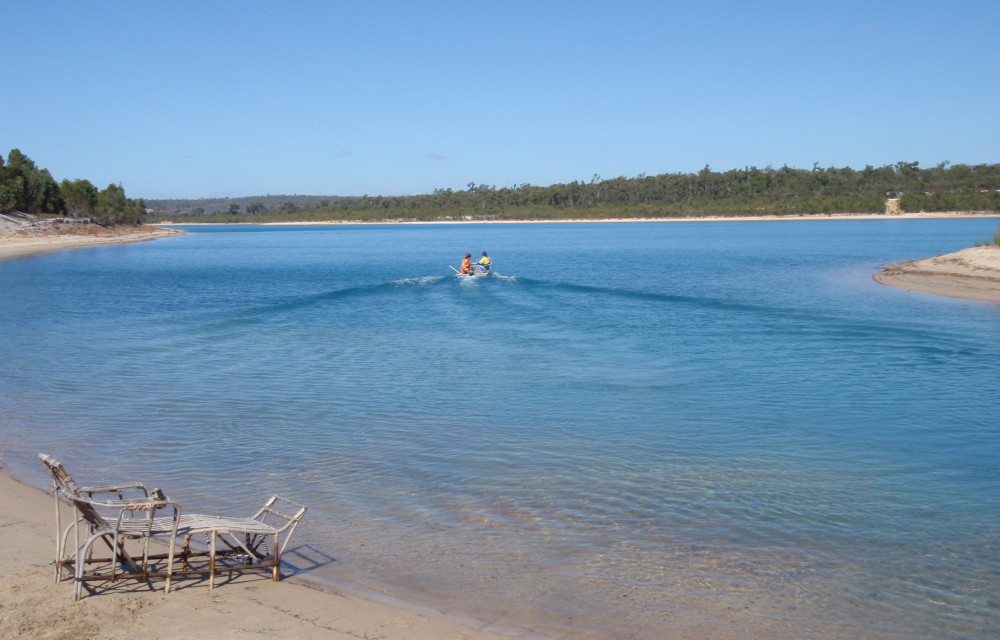
There is an armchair on the beach of a closed pit lake and the gates are locked. Which tells you much of what you need to know about mine water safety

, , , , , , , , , , , , , , , , , , , ,
, , , ,
Mine water safety conversations default to tailings dams, but Dr Cherie McCullough spent an hour explaining why the larger risk is day to day exposure to as little as 1.5 metres of water and a person who should not be there.
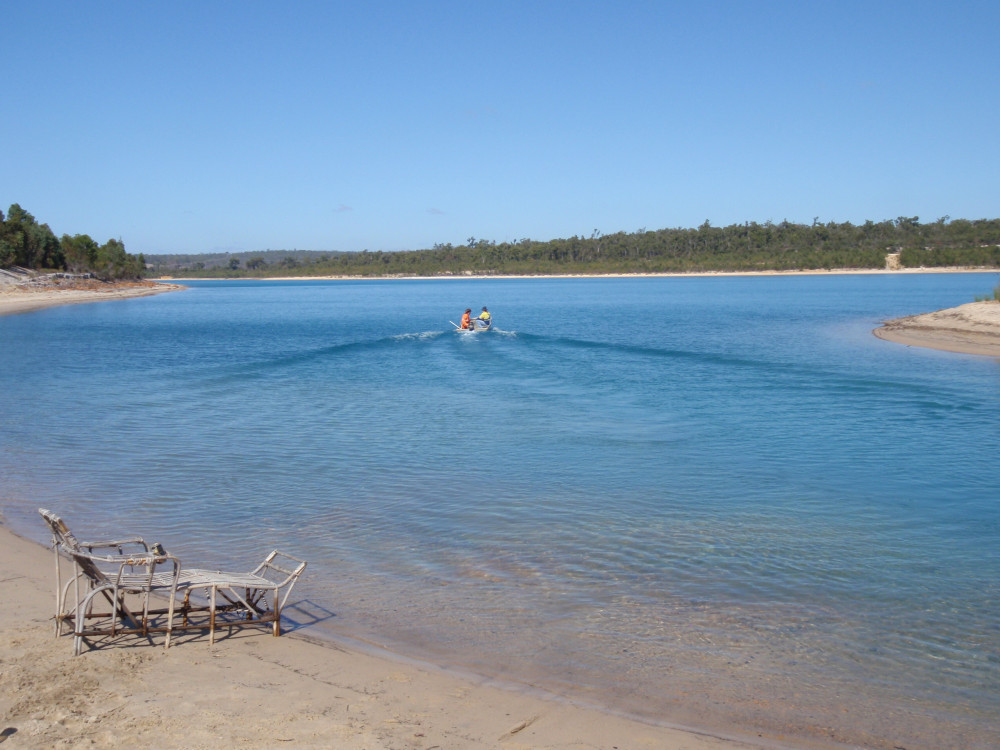
There is an old wicker recliner on the beach of a lake that has formed in a closed mine pit in Western Australia. The tenement is yet to be relinquished. The lake is in a remote rural area. The gates are locked. And the water sits at roughly the acidity of lemon juice from acid mine drainage. Yet someone dragged the chair down there anyway.
Dr Cherie D. McCullough, Director and Principal Environmental Scientist at Mine Lakes Consulting, used that photograph to make a point that rarely survives contact with a site risk register. Water attracts people. Signage and fencing do not change that. Nor do they completely absolve liability.
Speaking at an AusIMM webinar on Tuesday 4 August 2026, Cherie was asked what safety means across a whole mine water system. She acknowledged the obvious starting point and then deliberately set it aside.
Tailings storage facilities carry a higher failure frequency than water resource dams, along with a chemical risk and a legacy that water storages do not, she said. They also already carry the governance, through instruments such as the Global Industry Standard on Tailings Management (GISTM).
What she wanted to talk about was everything else on a mine site that holds water, which on her account harms more people each year than a tailings dam does.
Drowning belongs at the top of the matrix
Cherie frames this as a safety assessment problem rather than an environmental one.
"Drowning is really important! We know that intrinsically, so if we think about any water body from a risk assessment point of view, we have a very high consequence straight away."
That consequence is fatality, and the hazard exists in some form on almost every operating and closed site in the country.
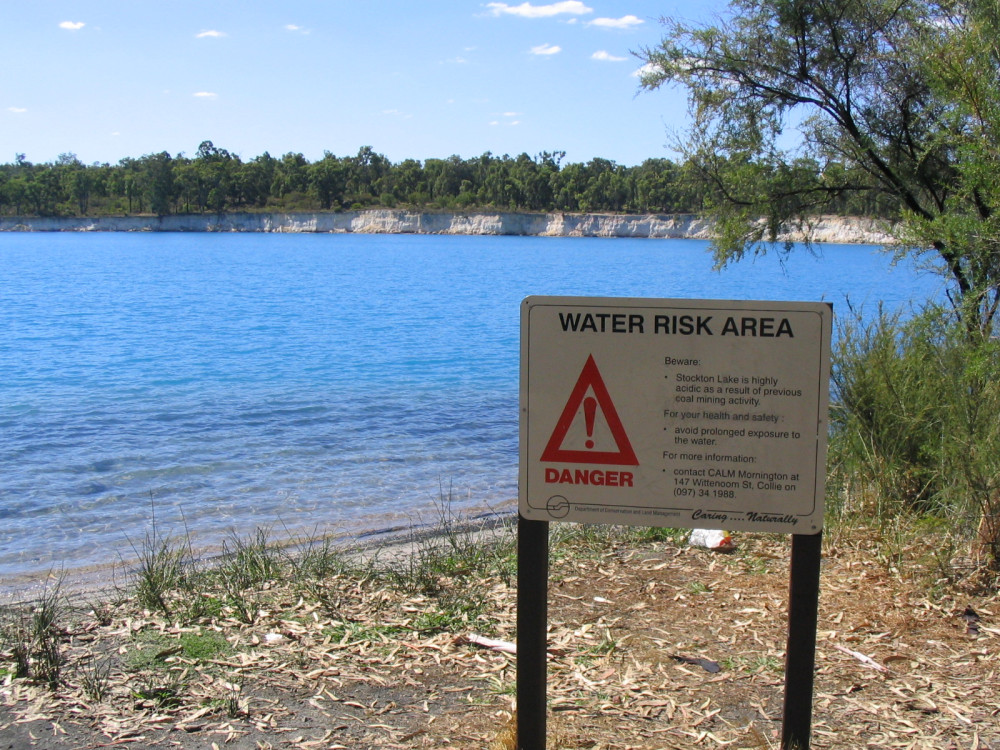
She pointed to a historical Western Australian pit lake, roughly 80 years old and about 500 metres from the main road into a mining town. She is aware of about three drownings there in the past 20 years, and of a person left quadriplegic after riding a dirtbike off a high wall.
Until the high wall was recently regraded by the State government, teenagers used to leap from it into water some 20 metres below, where an uppermost bench sat just beneath the surface, obscured by water made cloudy by eroding bench faces.
At two other closed Western Australian water bodies, jet skis have collided in the past few years. Jet skis. On "closed" mine sites.
The physical threshold is far lower than most people assume. About 1.5 metres of water is enough to defeat most adults, and considerably less will defeat a child. A bench that drops away suddenly delivers that in a single step.
Photogenic water is compounding the problem, and cheap, plentiful drones now deliver the panoramas. Spectacular pit lake colours travel well on social platforms, and the sites that host them are becoming easier to find and easier to reach once sharing websites advertise the aesthetics and a GPS location alongside them.
Steel cap boots do not float
The operational version of this is more mundane and considerably more fixable.
Mine staff working around site water bodies are typically well equipped for every hazard except the one directly in front of them. Hard hat, safety glasses, gloves, steel capped boots.
"But do they have a life jacket? Because it is quite hard to swim in steel cap boots."
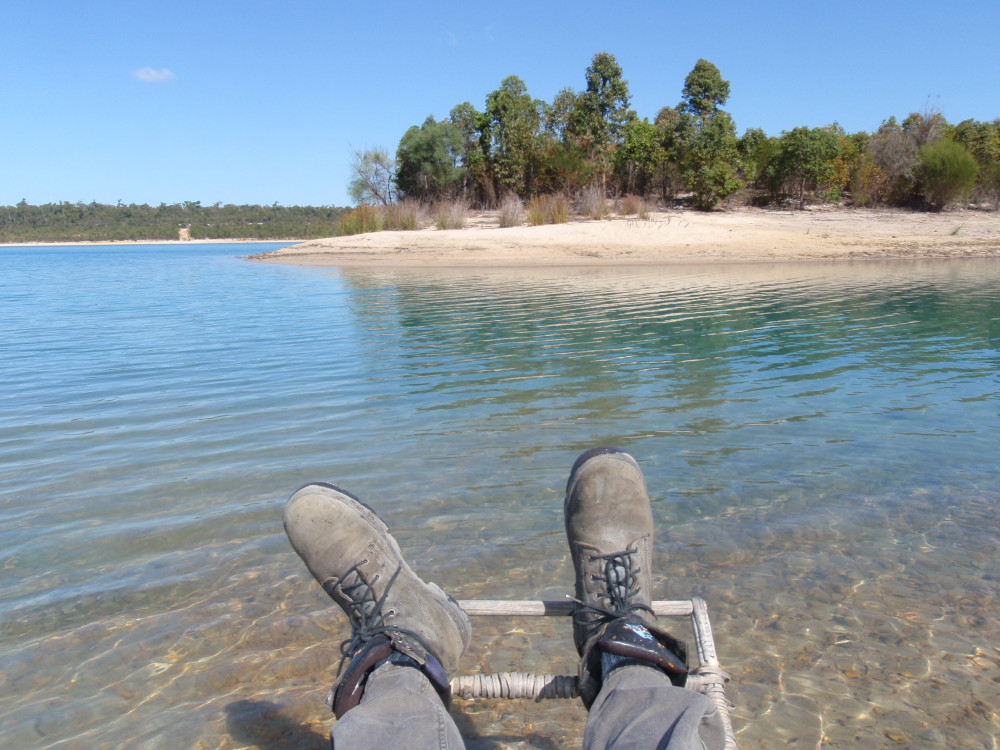
Standard site footwear at the water line of a pit lake. Steel caps are rated for every hazard on site except the one in front of them. Image credit: Cherie D. McCullough, Mine Lakes Consulting
Cherie’s second practical control is egress. Getting into a stormwater retention pond, a sediment pond or a process water storage is not hard, because falling is easy. Getting out is the part nobody has designed for.
A knotted rope down the side of a structure is a low cost fix that most sites do not have. The same logic applies to every water holding structure, whether or not it sits behind a fence.
Care and maintenance is when the controls come off
The exposure to drowning does not end when the operation does. It arguably peaks.
Sites in care and maintenance carry reduced security, reduced surveillance and, as a direct consequence, reduced safety controls. The water is still there. The attraction is still there. The people watching are not.
Research Cherie conducted for a major miner found that swimming risk is greatest in remote and hot locations, which describes most of the key mining regions across Australia, precisely because that is where recreational alternatives, public education and rescue capability are thinnest.
"Fences are great, signs are great. They prevent inadvertent access, but they do not prevent deliberate access. And a drowning is a drowning, no matter whose fault it was."
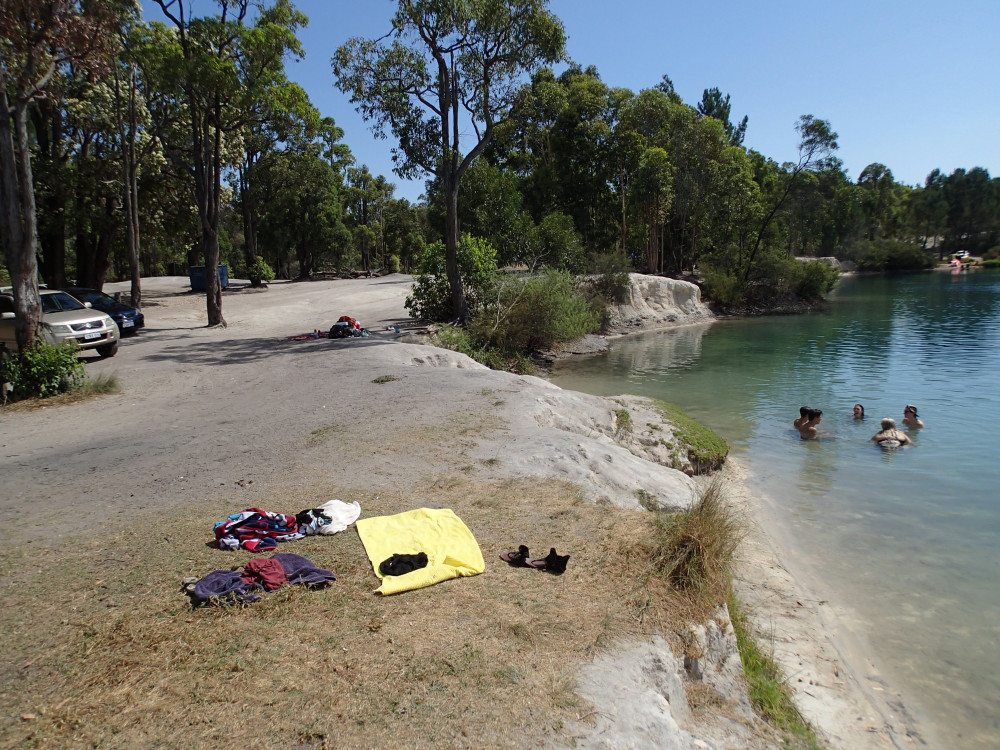
Cars parked, towels down and swimmers in the water at a former mine void. Deliberate access, on a hot day, at a site nobody is watching. Image credit: Cherie D. McCullough, Mine Lakes Consulting
That last clause is the commercial point. Unsecured water bodies are described in legal language as attractive nuisances, and fault allocation after the event does not restore a social licence, close out a coronial process or shorten a relinquishment timeline.
The hazards that are not the lake
Beyond open water drowning, Cherie set out a series of exposures that sit outside most site water management plans.
Entrapment in structures. Culverts and drainage structures running under roads and through communities attract curious people and can trap them.
Entrainment at pumps. Where water is drawn from or discharged into an environment that people access, both the intake and the discharge are hazards.
Seawall failure. She showed footage of a 1993 sea wall collapse at a coastal tin mine in Malaysia that generated an almost instant pit flooding wave. In that case everyone got out in time. The relevance is that open cut mines still operate very close to large water bodies, whether that is the ocean or a river.
Biological water quality. On site reservoirs and ponds can carry disease causing bacteria and hazardous algal blooms, which is a different class of problem from the geochemistry that usually dominates mine water discussion.
Acidity, counterintuitively, ranks lower for recreational risk and is more often a long term issue. Health risk research Cherie has undertaken on the acidic lakes at Collie found that the health benefit of the recreational opportunity outweighed the water quality issue. The drowning risk is what persists.
Potable water should be treated as a critical safety system, not a site service
The final exposure sits closest to the workforce.
Mine camps are small communities operating without the water treatment robustness of a town supply. A burst pipe, a cross connection between lines, or a change of source from groundwater to surface water can introduce a microbiological problem quickly.
Cherie also flagged naturally elevated nitrate in some Western Australian groundwater, which carries a specific risk to pregnant women through blue baby syndrome and has been raised as a worker safety issue in the state.
Workers drink several litres a day, and more in the hot and humid conditions of many remote mining regions. Her recommendation is a regularly monitored system with active disinfection, rather than an assumption that the incoming water comes from a clean source. Groundwater sources often carry fewer health risks than surface water environments, which are exposed to weather events and to fouling by wild animals and livestock.
What this means on site
Six things a site can act on without engaging a consultant:
- Audit every water holding structure on site, not just the tailings facility, as a safety hazard rather than an environmental one.
- Check egress on each one. Rope, ladder or graded exit point. Do not rely on PPE alone.
- Add water safety specific PPE where people work over or near hazardous water bodies.
- Treat care and maintenance transitions as an increase in access risk, not a decrease in activity. Restricting access into a water body can also restrict the way back out of it if somebody falls in.
- Verify the potable system as a treatment system with regular monitoring, including the risks created by work anywhere in the system and by unexpected changes in source quality.
- Check licensing. Any activity using boats on a mine site legally requires formal competency, such as commercial coxswain certification.
Cherie’s broader framing on mine water applies here as much as it does to water quality. The end user of the water is rarely the mine. It is a community, an environment, or a person who found a gap in the fence on a hot day.
The industry has built extensive governance around the water it is worried about. The exposure sits in the water it is not.