
Saturn Metals ramps up Apollo Hill with big rigs, low costs and a heap leach game plan set to shake up the WA gold scene

, , , , , , , , , , , , , , , , ,
, ,
,
A new bulk-tonnage gold project in Western Australia is shaping up as a standout case study in low-cost development and practical innovation, as it advances toward full-scale heap leach production with big rigs, tight metallurgy, and a streamlined cost base.
The project, led by Saturn Metals and centred on the 2.03Moz Apollo Hill deposit near Leonora in the Eastern Goldfields, was presented at this month’s RIU Sydney Resources Round-up by managing director Ian Bamborough. His pitch was clear: scalable simplicity wins the game.
“All our ounces are sitting in one low-strip, wide-open pit—and we’ve designed this around efficiency, not complexity,” Ian told the audience. “This is a volume business. And with predictable metallurgy and big mining gear, we’re aiming for maximum margin on a low operating cost base”.
BSc (Hons), MSc, MBA, MAIG, GAICD
The orebody lends itself well to this strategy. With a stripping ratio of 1.5:1 and mineralisation widths up to 180m, it’s designed for face shovels and 90–100 tonne trucks. The company is modelling operations around 10m benches—“big selective mining units,” Ian said—enabling productivity gains that put typical narrow-scale gold pits in the shade.
But the real kicker is the metallurgy. All gold is hosted in quartz with no deleterious elements—ideal for heap leaching. Testwork shows 78–88% recoveries with HPGR crush (8mm and 4mm respectively), and all curves cluster predictably regardless of ore type or grade. This predictability, Ian noted, “means simple stacking schedules, low re-agent use, and no need for a mill, power plant, or energy-intensive grinding circuit.”
The result? A low unit cost. The company’s PEA, based on 10Mtpa throughput, forecast ASIC of AUD 1,857/oz and processing costs of just AUD 9.42/t—numbers that outclass many CIL operations. “We’re looking at AUD 24/t all-in. That’s game-changing when you’re aiming for 122,000 ounces a year,” Ian said.
And with gold prices pushing north of AUD 4,500/oz, Apollo Hill’s metrics stack up sharply. While the base-case PEA used AUD 2,665/oz and returned an NPV of AUD 388M and IRR of 30 percent, higher price scenarios push those numbers into billion-dollar territory with a payback inside two years.
Saturn is currently mid-way through a 60,000m drill program (45,000m completed at the time of presentation), with rigs chasing both in-pit extensions and deep step-out targets that could take the daily throughput scenario from 30,000t to 45,000t. “We’re building a platform for DFS and reserve declaration this year, but we won’t stop drilling,” Ian said. “The aim is to deliver even more ounces and optionality as we go”.
On the development front, the company has appointed US-based heap leach specialists Kappes, Cassiday & Associates to steer its PFS. Early-stage engineering layouts include HPGR crushers, agglomerators, and modular pads, with all key permitting applications now lodged for mining, water, and plant works.
Saturn is also keeping the door open on a staged start. While a standalone 1.2Mt bulk sample option has been shelved, the PFS is evaluating contractor-led ramp-up models, including 1Mtpa and 3Mtpa options before scaling to 10Mtpa. “We’ve built in that flexibility,” Ian said. “Low capex pathways that still align with our full-scale plan”.
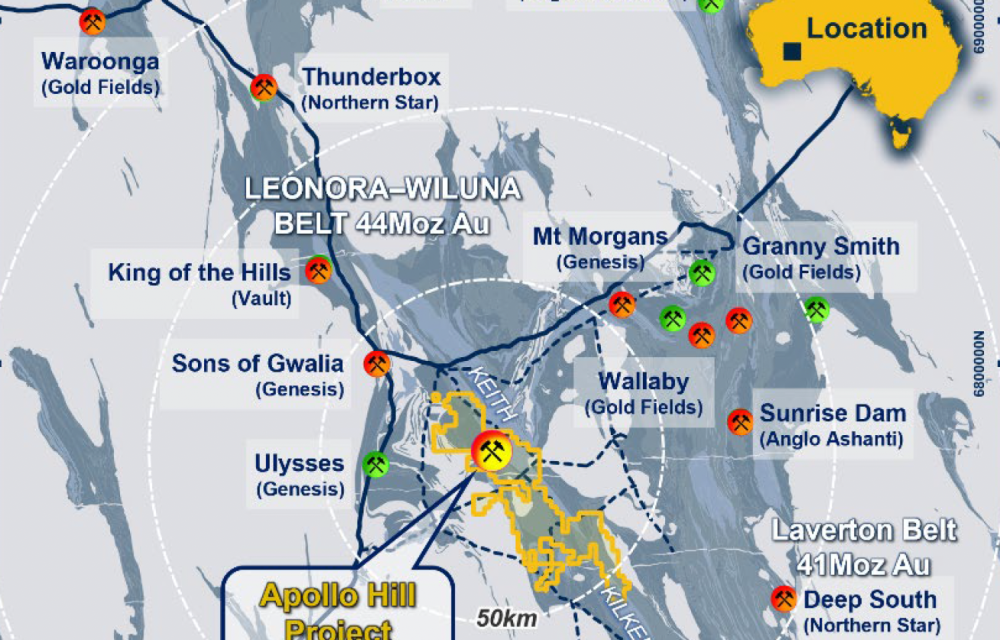
Beyond the main pit, Saturn holds a commanding 1,000 square kilometre land position across underexplored greenstone with 16 identified prospects and a further 12,000m of exploration drilling to come in 2025. “This is a district-scale gold system that’s never really had a chance to shine,” Ian said. “We think another Apollo Hill—or something better—could be sitting just over the ridge.”
In terms of operational intent and technical execution, Apollo Hill is shaping up as one of the few WA gold projects capable of delivering scale, margin, and simplicity through heap leach processing—an area where few Australian developers tread, but where global giants thrive.
“We’ve got the asset, the plan, the cash, and now the right team and partners,” Ian said. “If you’re in the METS space, now’s the time to be watching."
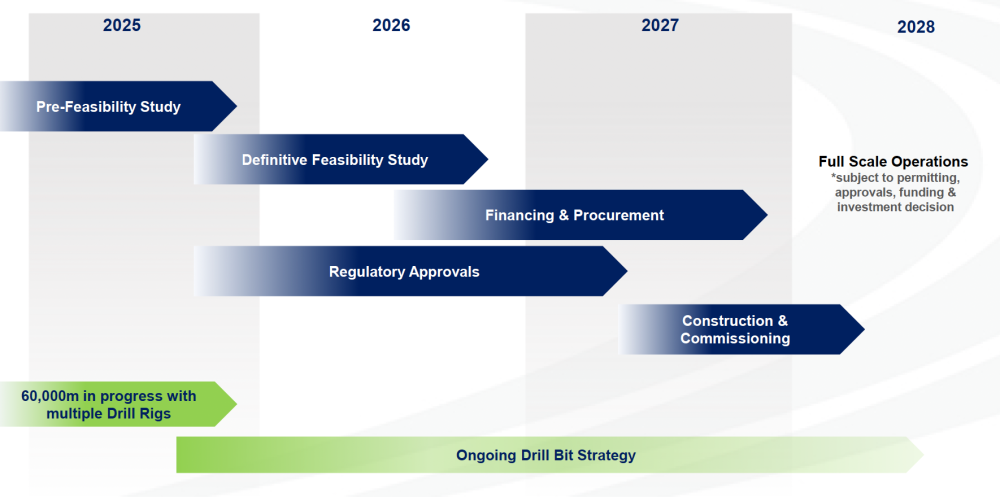
Timeline to full-scale production.