
What lies beneath might surprise you as site characterisation gets a tailings-fuelled rethink driven by smarter tools sharper data and braver decisions

, , , , , , , , , , , , , , , , , , , ,
,
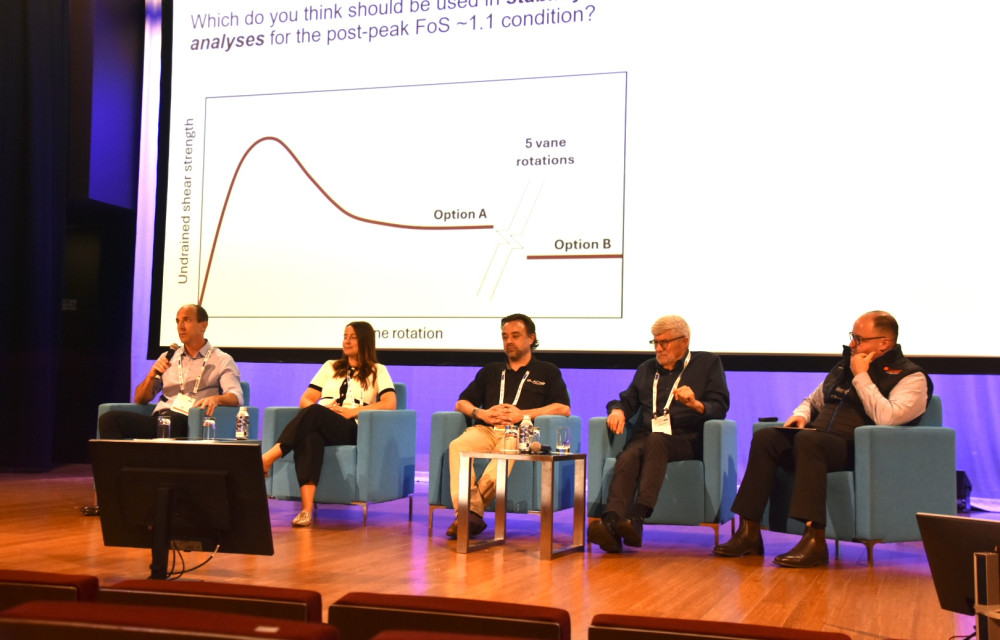
At the AusIMM 2025 Life of Mine - Mine Waste and Tailings Conference in Brisbane, a standout panel on site characterisation dug deep into the evolving challenges - and innovations - facing tailings engineers. Convened late on day one, the session brought together some of the most respected names in the field, including geotechnical pioneers, lab specialists, and industry disruptors who’ve spent decades testing and retesting the ground beneath our feet.
Facilitated by Symon Jackson, managing director and founder of Red Earth Engineering (a Geosyntec company), the session tackled one of the most fundamental yet fluid aspects of tailings management: how do we know what we’re standing on - and how much can we trust that knowledge?
Site characterisation: not about quantity, but quality
Symon framed the discussion with a nod to the multidisciplinary reality of modern tailings engineering. “Site characterisation is fundamental to the decisions we make,” he said. “It’s not just about the data we collect - it’s about whether we can rely on it to make the right calls.”
Symon, who also chairs the ANCOLD Tailings Advisory Group and serves on multiple Independent Technical Review Boards, highlighted the growing complexity of the EOR role. “You need a strong team around you. No single person can be across everything - especially not in today’s regulatory and technical climate,” he added.
A tale of two samples: lab vs nature
The most provocative moments came courtesy of Dr David Reid, principal tailings engineer at Red Earth Engineering, who presented the results of a series of crowd-sourced polls he conducted among tailings practitioners. One central question: can material in the field be looser than anything we can prepare in the lab?
David’s conclusion? Absolutely - and most engineers agree.
“When I ran this poll, over 300 people responded,” said David. “The majority - especially those working in tailings - said it’s entirely possible for subaqueous tailings in the ground to be looser than anything we can make in the lab. That runs counter to what many academics assume.”
He contrasted this with lab-based views, which often take the slurry-deposited sample as the loosest achievable state. “But when you ask people whether they’d discard field results that appear looser than lab samples, almost nobody does,” he noted. “Even those who claim lab samples are the baseline - when it comes to the crunch - they trust the field.”
For David, this tension reveals a deeper truth: “Science shouldn’t be poll-driven, but it’s useful to understand where the profession is heading - and where there’s disconnect between theory and lived experience.”
From friction to brittleness: revisiting assumptions
The panel didn’t shy away from technical nuance. When asked whether sleeve friction in CPT testing could be used to infer residual shear strength, Allan McConnell - founder of Insitu Geotech Services and a geotechnical engineer with more than 45 years of experience - was blunt: “Conventional cones can’t reliably measure the very low sleeve friction in soft tailings because of the internal friction in the seals. It’s a design limitation - and a major issue in soft materials.”
Later, the conversation turned to the brittleness index in monotonic shear tests. David explained that while direct simple shear (DSS) testing offers conceptual advantages, it’s plagued by poor saturation and difficulty in measuring true shear stress. “If done right - saturated, biased appropriately - the DSS has real value in brittle assessment. But most people aren’t doing it right,” he warned.
This emphasis on nuance and context ran throughout the discussion. Whether dealing with overconsolidated clays under tailings blocks or evaluating post-peak shear strength, panellists urged practitioners to match methods to materials - and question long-held assumptions.
Emerging tools, evolving minds
Tierney Boulter, business development manager at Menard Oceania and former managing director of Conetec, offered insights into innovation around the piezovane - a modified tool that accounts for drainage conditions during testing.
“One of the drivers behind the piezovane was to reduce uncertainty in intermediate soils and tailings materials,” said Tierney. “In practice, we often adjust the rotation rate above ASTM standards, which were developed for highly cohesive clays. But what about pore pressures during testing? That’s the missing link.”
She encouraged delegates to rethink how they assess shear strength in these complex materials and to look out for more research to come.
Billy Burke, director of Black Geotechnical and Black Insitu Testing, echoed the call for better tools. His companies have spent years refining seismic and surface wave testing and recently began developing mini block sampling for tailings.
“It’s not just about the tool - it’s about the data quality,” said Billy. “You can push anything into the ground, but the question is: do you believe what you’re getting back?”
Billy also cited contrasting conference papers on saturation fluids - glycerin vs silicon oil - as a reminder that “tailings react differently depending on their chemistry, and geochem is a huge missing piece in many site characterisation programs.”
A new era for geotech?
For Allan, the transformation of site characterisation isn’t just about tools - it’s about the profession itself. “Tailings have pushed geotechnical engineering forward. For years, geotech was stagnant - people were still talking about SPTs. Now we’re dealing with critical state testing, contractive and dilative behaviour. That’s a huge leap.”
He cited rapid advances in CPT speed, rotational shear devices, and large-diameter sampling as signs of progress. “You can now get samples so undisturbed they’re only compromised after handling in the lab,” he said. “That’s a paradigm shift.”
Tierney agreed. “What’s really exciting is how much of this innovation comes from collaboration - consultants, academics, contractors all working together. That’s what’s driving change.”
Final reflections: collaboration, caution, and curiosity
As the panel wound down, Symon circled back to the fundamentals. “Tailings don’t tell you if they’re drained or undrained. They don’t tell you if they’re contractive or dilative. You have to figure that out. And that takes good data, good people, and a collaborative approach.”
Asked whether he’d take on an EOR role again, Allan responded with humour, but ultimately highlighted the seriousness of the responsibility. His message was clear: site characterisation in today’s context requires more than technical knowledge - it demands strong judgment, collaboration, and support.
It was a reminder that in an era of increasing accountability, site characterisation is about far more than numbers. It’s about judgment, responsibility, and trust - in your data, your tools, and your team.
And, as the panel made clear, in tailings engineering, that trust is only as good as your understanding of what lies beneath the surface.